<?xml version='1.0' encoding='UTF-8'?>

<!DOCTYPE article PUBLIC "-//NLM//DTD JATS (Z39.96) Journal Publishing DTD v1.1d1 20130915//EN" "JATS-journalpublishing1.dtd">
<article xmlns:xlink="http://www.w3.org/1999/xlink">
  <front>
    <journal-meta id="journal-meta-87cddb9ab7774ac9973b6a64b7cbc767">
      <journal-id journal-id-type="nlm-ta">Sciresol</journal-id>
      <journal-id journal-id-type="publisher-id">Sciresol</journal-id>
      <journal-id journal-id-type="journal_submission_guidelines">https://jmsh.ac.in/</journal-id>
      <journal-title-group>
        <journal-title>Journal of Medical Sciences and Health</journal-title>
      </journal-title-group>
      <issn publication-format="print"/>
    </journal-meta>
    <article-meta>
        
          
            <article-id pub-id-type="doi">10.53989/jcp.v5i2.26.28</article-id>
          
          
            <article-categories>
              <subj-group>
                <subject>REVIEW ARTICLE</subject>
              </subj-group>
            </article-categories>
            <title-group>
              <article-title>&lt;p&gt;Analysing the China Factor in the Indo-Pacific Strategy of the EU and India&lt;/p&gt;</article-title>
            </title-group>
          
          
            <pub-date date-type="pub">
              <day>30</day>
              <month>3</month>
              <year>2026</year>
            </pub-date>
            <permissions>
              <copyright-year>2026</copyright-year>
            </permissions>
          
          
            <volume>5</volume>
          
          
            <issue>2</issue>
          
          <fpage>1</fpage>

          <abstract>
            <title>Abstract</title>
            &lt;p&gt;This paper examines how the China factor shapes the Indo-Pacific Strategy of the European Union (EU) and India, particularly in the post-Russia-Ukraine War. The EU and India share the common strategic interests of a free, open, inclusive, and rule-based maritime order in the Indo-Pacific region. India and the EU have acknowledged that China’s assertive stance and strategic ambitions present significant security concerns in the Indo-Pacific region. Recognising India’s strategic weight in the region, the EU intended to boost cooperation with India to build a robust maritime order, mitigating the disruptive and destabilising role of China. However, the unprovoked Russia–Ukraine War since 2022 has changed its strategic priorities and significantly altered its threat perception toward China. India’s long-standing ties with Russia contrast with the EU’s sanction-driven stance, necessitating nuanced approaches to bilateral and multilateral engagements. This paper maps the increasingly complex interactions between India and the EU in the Indo-Pacific as they navigate the multifaceted impacts of the Russia–Ukraine war. The paper explores how the Russia–China strategic partnership has intensified regional power struggles, compelling both India and the EU to reassess their policies toward Moscow. This study also analyses how India and the EU, each with its unique set of challenges and opportunities, can leverage their cooperation in the Indo-Pacific through stability, economic resilience, and sustainable security architecture amid escalating global geopolitical challenges.&lt;/p&gt;
          </abstract>
          
          
            <kwd-group>
              <title>Keywords</title>
              
                <kwd>Russia-Ukraine War</kwd>
              
                <kwd>Indo-Pacific Strategy</kwd>
              
                <kwd>China</kwd>
              
                <kwd>EU</kwd>
              
                <kwd>India</kwd>
              
                <kwd>Geopolitics</kwd>
              
            </kwd-group>


        <contrib-group>
          
            
              <contrib contrib-type="author">
                <name>
                  <surname></surname>
                  <given-names>J Jeganaathan</given-names>
                </name>
                
                  <xref rid="aff-1" ref-type="aff">1</xref>
                
              </contrib>


              <aff id="aff-1">
                <institution> Associate Professor, Centre for European Studies School of International Studies at Jawaharlal Nehru University </institution>
                <addr-line>New Delhi India</addr-line>
              </aff>
            
              <aff id="aff-2">
                <institution> Postdoctoral Researcher School of Law and Government, Dublin City University </institution>
                <addr-line> Ireland</addr-line>
              </aff>


              <contrib contrib-type="author">
                <name>
                  <surname>Sinha</surname>
                  <given-names>Shreya</given-names>
                </name>
                
                  <xref rid="aff-2" ref-type="aff">2</xref>
                
              </contrib>


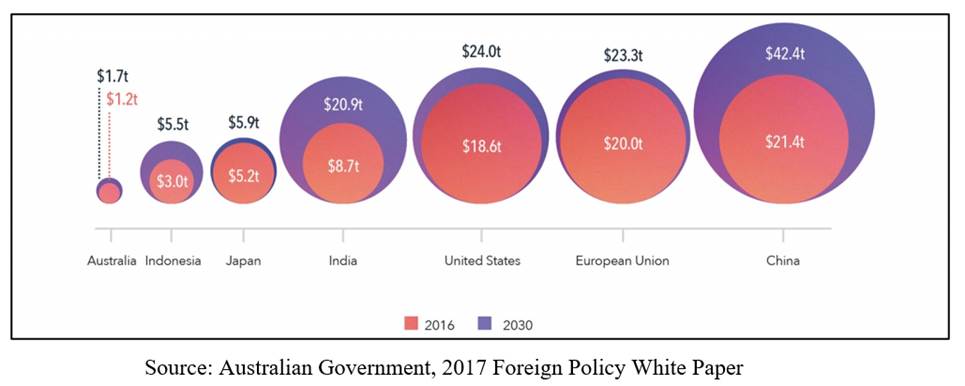
              <aff id="aff-1">
                <institution> Associate Professor, Centre for European Studies School of International Studies at Jawaharlal Nehru University </institution>
                <addr-line>New Delhi India</addr-line>
              </aff>
            
              <aff id="aff-2">
                <institution> Postdoctoral Researcher School of Law and Government, Dublin City University </institution>
                <addr-line> Ireland</addr-line>
              </aff>
            
          
        </contrib-group>
        
    </article-meta>
  </front>
  <body>
    <heading><span><bold>INTRODUCTION</bold></span></heading><p><span>The geopolitical dynamics of the Indo-Pacific region have become increasingly intricate due to China's ascendant influence, presenting substantial challenges for both the European Union (EU) and India as they endeavour to assert their strategic interests. The notion of the Indo-Pacific as a cohesive geoeconomic and geopolitical entity linking the Pacific and Indian Oceans has gained prominence in recent years, signifying a shift in the global power balance from the Atlantic towards the east<superscript>[<xref ref-type="link" rid="#ref-21">21</xref>]</superscript>.</span></p><p><span>The increasing interconnectedness of globalisation, permeable borders, trade dependency, and the seamless integration of maritime networks, alongside the transnational nature of maritime threats, has effectively dissolved traditional physical boundaries. The Indo-Pacific region is now home to over half of the global population, accounts for more than 60% of the world's GDP and two-thirds of global economic growth, rendering it a burgeoning geopolitical asset. The United States' "Pivot to Asia" policy, initiated under the Obama administration to ensure continued American dominance in the region, has been a significant catalyst for this shift<superscript>[<xref ref-type="link" rid="#ref-45">45</xref>]</superscript>. Concurrently, Russia is reasserting itself as a Euro-Pacific power through its own "Asian pivot"<superscript>[<xref ref-type="link" rid="#ref-21">21</xref>]</superscript>.</span></p><p><span>In this context, the European Union (EU) and India are formulating their own Indo-Pacific strategies to navigate the intricate web of regional rivalries and power dynamics. The EU's Indo-Pacific strategy, introduced in 2021, seeks to promote a "free and open Indo-Pacific" and to strengthen partnerships with key regional actors, including India, Japan, and Australia<superscript>[<xref ref-type="link" rid="#ref-44">44</xref>]</superscript>. Similarly, India is actively participating in various multilateral frameworks, such as the Quadrilateral Security Dialogue with the United States, Japan, and Australia, as well as bilateral and regional initiatives, to counter China's expanding influence and uphold a rules-based order in the Indo-Pacific region<superscript>[<xref ref-type="link" rid="#ref-11">11</xref>, <xref ref-type="link" rid="#ref-30">30</xref>]</superscript>.</span></p><p><span>Nevertheless, China’s influence presents distinct challenges for both the European Union (EU) and India. As the EU endeavours to balance its economic and geopolitical interests with those of China, it has encountered criticism for its perceived lenient stance on Chinese human rights violations and the absence of a unified China policy among member states<superscript>[<xref ref-type="link" rid="#ref-21">21</xref>]</superscript>. A pivotal factor shaping these strategies is China's rapid economic and military ascent, which has raised concerns among regional neighbours and Western powers. This ascent is characterised by initiatives such as the Belt and Road infrastructure project and assertive actions in the South China Sea region.</span></p><p><span>These actions are driven by Beijing’s increasing ambition to reshape the regional and international order in alignment with its interests. Conversely, India must navigate a more complex relationship with China, given their long and often tense history, including ongoing border disputes. Nonetheless, both the EU and India have acknowledged the significance of the Indo-Pacific region and the necessity of developing robust strategies to address the Chinese challenge and advance their respective interests in this dynamic and rapidly evolving geopolitical landscape<superscript>[<xref ref-type="link" rid="#ref-18">18</xref>]</superscript>.</span></p><heading><span><bold>INDIA’S INDO-PACIFIC STRATEGY</bold></span></heading><p><span>India's adoption of the Indo-Pacific concept as a strategic framework, now a fundamental aspect of its foreign policy, was driven by China's increasing influence in South Asia and the Indian Ocean. While this development initially motivated countries such as the USA and Japan to integrate India into the region's security architecture, the Indo-Pacific now presents an opportunity for India to expand its influence across the region. The Indo-Pacific signifies a new domain in India's foreign policy engagements, marking a shift in New Delhi's strategic environment from focusing solely on continental threats to encompassing maritime concerns<superscript>[<xref ref-type="link" rid="#ref-4">4</xref>]</superscript>.</span></p><p><span>India's priorities in the Indo-Pacific region emphasise maintaining inclusiveness and openness. New Delhi advocates for a 'free and open Indo-Pacific,' ensuring that all countries adhere to international law and benefit from freedom of navigation. Given the region's role in global trade and energy resource distribution, India has concentrated on enhancing maritime awareness, safeguarding critical sea lanes, and initiating multiple connectivity projects to bolster trade, investment, and economic dialogue.</span></p><p><span>India's Indo-Pacific strategy is founded on four pillars<superscript>[<xref ref-type="link" rid="#ref-22">22</xref>]</superscript>. These include collaboration with other actors to address shared concerns through partnerships, avoiding alliances of containment and advancing shared values and commitments. India's engagement with the Indo-Pacific is attributed to its strategic location. Additionally, China's growing presence in the region has threatened India's position as a primary security provider and regional power. China's ambitious Belt and Road Initiative (BRI), announced in 2013, aims to address the lack of infrastructure and investment in Asia, thereby increasing Chinese presence and engagement in the Indian Ocean. </span></p><p><span>The relationship between India and China is characterised by a juxtaposition of cooperation and conflict. Both nations serve as pivotal entities within the Global South and aspire to amplify their influence in international affairs. However, tensions at the Indo-Chinese border, among other points of divergence, have contributed to friction, prompting a more coherent Indian policy in the Indo-Pacific. Importantly, India's evolving perceptions of the Indo-Pacific are not solely a reaction to Beijing. During his 2007 visit to India, Japan's Prime Minister Shinzo Abe, in his parliamentary speech, introduced the concept of the 'confluence of the two seas,' emphasising the interconnectedness of the Pacific and Indian oceans.</span></p><p><span>This aligns with Indian Prime Minister Narendra Modi's Act East Policy, exemplifying the desire for an inclusive regional architecture. In 2015, India's vision of the Indian Ocean was exemplified through the SAGAR philosophy—Security and Growth for All in the Region. By 2018, the Indo-Pacific had progressed into an official policy framework, as articulated by the prime minister's keynote address at the Shangri-La Dialogue. In his speech, he clearly contextualised the geographical scope of the region, ranging from Africa to the Americas, encompassing both the Indian and Pacific Oceans. India's strategy towards the Indo-Pacific has been to utilise the region to advance its own strategic interests and respond to an evolving security environment.</span></p><p><span>Arising from its "Look East" and "Act East" policies, India's Indo-Pacific Strategy extends beyond concerns of trade and connectivity to include other strategic considerations. The strategy can be understood as a "subset of its China Policy which includes contradictory elements of balancing China by building partnerships with the United States as well as with regional powers, while simultaneously pursuing a reassurance strategy to convince Beijing that India is not truly balancing China"<superscript>[<xref ref-type="link" rid="#ref-31">31</xref>]</superscript>. Rajagopalan described these contradictory elements as "evasive balance" rather than pure balancing or hedging.</span></p><p><span>The Indo-Pacific region is predominantly characterised by the rivalry between the United States and China, with India playing a geopolitically and geo-strategically pivotal role. As a proponent of a free and open liberal vision in the region and a member of the QUAD, India’s status and agency have significantly elevated. While India perceives security cooperation as a crucial tool for managing China's expanding influence, its strategic outlook also encompasses the COVID-19 pandemic, Russia's invasion of Ukraine, and their combined impact on India's defence budget<superscript>[<xref ref-type="link" rid="#ref-14">14</xref>]</superscript>.</span></p><p><span>India continues to prioritise the formation of soft-balancing coalitions while maintaining a limited hard balancing relationship with the United States. Vinodan and Kurian assert that "India’s somewhat neutral position on the Russian war on Ukraine and reluctance to join active military alliances in the Indo-Pacific indicates that hedging has value for maintaining India’s strategic autonomy and aspirations for great power status in the twenty-first century"<superscript>[<xref ref-type="link" rid="#ref-39">39</xref>]</superscript>.</span></p><p><span>Owing to India's long-standing ties with Russia and its perception of China as an economic asset in the long term, India does not seek to completely decouple from Russia or China. India's ongoing and strategic engagement with multilateral and regional institutions such as BRICS, SCO, and G20, along with increased trade with China and Russia, underscores the significance of a hedging strategy in its strategic relations with other major powers. India has eschewed traditional alliance formation and formal institutions, instead fostering a new kind of liberal regional space<superscript>[<xref ref-type="link" rid="#ref-46">46</xref>]</superscript>. India's emphasis on inclusiveness and its refusal to accept external judgment on its democratic identity have reshaped the Indo-Pacific order towards greater pluralism and diversity.</span></p><heading><span><bold>EU’S INDO-PACIFIC STRATEGY</bold></span></heading><p><span>In April 2021, as the Indo-Pacific narrative gained global prominence, the European Union (EU) unveiled its strategy for the region. This strategy politically commits the EU to the Indo-Pacific with the objective of "contributing to its stability, security, prosperity, and sustainable development, based on the promotion of democracy, rule of law, human rights and international law"<superscript>[<xref ref-type="link" rid="#ref-16">16</xref>]</superscript>.</span></p><p><span>Historically, the Indo-Pacific region has been overlooked by the EU, and the motivations for the supranational organisation to engage with it are both geostrategic and geoeconomic. Although Europe's influence in the Indo-Pacific has been limited, its interest in the region is significant. Given the Indo-Pacific's centrality to global value chains, international trade, and investment flows, as well as its emergence as a hub for digital technologies, the EU has opted to constructively engage with the region. Additionally, China's unprecedented political influence, its global reach, and its revisionist stance in the Indo-Pacific have been primary catalysts for the EU's emergence as a relevant geopolitical actor in the region. </span></p><p><span>For decades, the relationship between the EU and China has been marked by a lack of shared vision and common goals. As normative actors, the EU's ideals of liberal democracy, the rule of law, and human rights are reflected in its policies of inclusiveness and openness in the Indo-Pacific, which stand in contrast to China's revisionist and strategic wolf-warrior diplomacy. The EU's perception of China as a "systemic rival promoting alternative models of governance" is articulated in the European Commission's report on EU-China: A Strategic Outlook<superscript>[<xref ref-type="link" rid="#ref-15">15</xref>]</superscript>. This scenario is attributed not only to China's alarming nationalist narrative but also to "Beijing's growing support for populist parties in Europe and Europe's frustrated inability to access the Chinese markets"<superscript>[<xref ref-type="link" rid="#ref-19">19</xref>]</superscript>.</span></p><p><span>In this context, the EU's engagement with the Indo-Pacific region coincided with a global pushback against China. However, despite shared concerns with several countries regarding the transparency of the Belt and Road Initiative (BRI), the EU appears to have adopted a pragmatic approach of coordination with China through its broader connectivity initiatives<superscript>[<xref ref-type="link" rid="#ref-19">19</xref>]</superscript>.</span></p><p><span>The European Union's (EU) connectivity strategy for linking Asia and Europe emerged at a strategically advantageous moment, coinciding with the increasing significance of the Indo-Pacific region and the prominence of 'connectivity' in European policy discourse<superscript>[<xref ref-type="link" rid="#ref-40">40</xref>]</superscript>. Within this framework, the EU's Global Gateway initiative in the region addresses the challenges posed by a rising China, offering target states a more secure alternative to the Belt and Road Initiative through its foundational principles of sustainability, comprehensiveness, and adherence to a rule-based order. Consequently, the EU is positioned to integrate economic growth with the reinforcement of liberal values, in collaboration with like-minded partners in the Indo-Pacific region<superscript>[<xref ref-type="link" rid="#ref-28">28</xref>]</superscript>.</span></p><p><span>The EU perceives the Indian Ocean as a crucial conduit for accessing Indo-Pacific markets, underpinning the rationale for an "EU pivot to Asia"<superscript>[<xref ref-type="link" rid="#ref-10">10</xref>]</superscript>. This pivot aims not only to bolster engagement with Asia to counterbalance China but also to expand involvement in vital global trade routes, markets, production hubs, and centres of geopolitical and geoeconomic decision-making.</span></p><p><span>In this context, the EU's Indo-Pacific Strategy signifies a new realm of strategic sovereignty and promotes multilateralism, while considering the evolving regional dynamics influenced by ongoing tensions between the U.S. and China, and simultaneously strengthening bilateral alliances in Asia.</span></p><p><span>The EU's Indo-Pacific Strategy facilitates productive engagement and enhanced cooperation in areas such as maritime security, ocean governance, sustainability and inclusive prosperity, digital governance and partnerships, human rights and democracy<superscript>[<xref ref-type="link" rid="#ref-47">47</xref>]</superscript>. Furthermore, given that human rights issues in the region pose a persistent challenge to regional security and stability, the EU's interests are directly affected, rendering it a strategic stakeholder in the Indo-Pacific. In light of Europe's diminishing global influence, the timely establishment of the EU's strategy not only grants the Union access to a region pivotal to the current global order but also presents an opportunity for the EU to emerge as a truly strategic geopolitical actor.</span></p><heading><span><bold>EVOLVING STRATEGIC PRIORITIES OF INDIA AND EU</bold></span></heading><p><span>India and the European Union (EU) occupy pivotal and stabilising roles in the Indo-Pacific region, particularly concerning maritime security and geoeconomic issues. Both entities are committed to developing a comprehensive maritime strategy to ensure strategic autonomy within the region. They have pledged to "foster a peaceful and rules-based Indo-Pacific while also attempting to rebalance their dependence on the US and China"<superscript>[<xref ref-type="link" rid="#ref-1">1</xref>]</superscript>.</span></p><p><span>Both actors seek partnerships to address common security challenges without compromising their strategic autonomy. The increasing awareness of the China factor has prompted India and the EU to adopt a non-confrontational stance towards Beijing, focusing on targeted strategic cooperation while simultaneously seeking alternatives to their geoeconomic reliance on China. In terms of their inclusive strategy in the region, India and the EU are more aligned than ever, aiming to enhance maritime security, connectivity, and growth in the Indo-Pacific. However, the Russia–Ukraine conflict has significantly impacted their strategic presence and priorities in the region. With the conflict intensifying in its vicinity, the EU finds itself in a catch-22 situation in the Indo-Pacific, whereas India has managed to manoeuvre its strategic interests by balancing China with Russia.</span></p><p><span>India's unique geographical position facilitates its potential role in the region, underscored by a rapidly evolving geostrategic environment with China's rise as an economic and military power. </span></p><p><span>Nonetheless, the full-scale Russian invasion of Ukraine in February 2022 has led to a re-evaluation of India's strategic priorities in the region. India's response to the invasion has been distinctive among major democracies globally, with New Delhi adopting a measured public and diplomatic neutrality towards Moscow<superscript>[<xref ref-type="link" rid="#ref-38">38</xref>]</superscript>. This contrasts with India's alignment in resisting Chinese assertiveness in the Indo-Pacific while maintaining strategic neutrality with Russia.</span></p><p><span>India's relationship with Russia dates back to 1955, and Russia has since become a reliable partner. Throughout the Russia–Ukraine conflict, India has maintained strong ties with Russia, recognising its ability to balance China in the Indo-Pacific." However, it is crucial to acknowledge the risks associated with India's public neutrality towards Moscow, as it raises questions about India's commitment to upholding the rules-based order in the Indo-Pacific, while the EU has been resolute in penalising Russia and has been at odds with India's stance on Ukraine.</span></p><p><span>The increasing antagonism between Russia and the US and Europe has driven Moscow towards a closer alignment with Beijing. Consequently, Sino-Russian relations influence Russia-India relations, particularly given the ongoing border disputes and strategic competition between India and China in Asia. Despite India's enduring relationship with Russia, it is improbable that cooperation will effectively counter China's assertiveness in the Indo-Pacific region, which poses the most significant threat to Indian interests.</span></p><p><span>The Ukraine crisis has fostered a deeper Sino-Russian relationship and diminished Moscow's independent role in the Indo-Pacific at a time when Sino-India relations were strained. Conversely, the war in Ukraine has exposed vulnerabilities in the European security architecture and redirected attention to Euro-Atlantic security. As Europeans have imposed unprecedented sanctions on Russia and significantly increased their defense spending through military support to Ukraine, Europe's inability to address security concerns beyond its borders has become apparent.</span></p><p><span>Although the EU's strategy emphasises inclusivity and cooperation, Beijing remains a significant challenge to European norms of a rule-based order. In this context, China's response to the Ukraine crisis indicates that Europe and the Indo-Pacific can no longer be viewed as separate, isolated theatres without common factors<superscript>[<xref ref-type="link" rid="#ref-43">43</xref>]</superscript>. For the EU, any initiative to counterbalance China's influence in the Indo-Pacific region may be perceived as part of a broader Western containment strategy. The EU's open opposition to Russia, including sanctions and support to Ukraine, further intensifies tensions in the Indo-Pacific due to strained EU-China relations.</span></p><p><span>The EU's dilemma in the Indo-Pacific region arises from its intertwined relationships with China and Russia, both of which challenge its strategic ambitions. On one hand, China serves as a crucial economic partner for many European countries. On the other hand, China's growing assertiveness in the Indo-Pacific increasingly positions it as a geopolitical adversary<superscript>[<xref ref-type="link" rid="#ref-27">27</xref>]</superscript>. This duality places the EU in a precarious position, as it seeks to balance economic dependencies with the need to uphold its values of democracy, human rights, and a rules-based international order. The Russia–Ukraine conflict further complicates this balancing act. Simultaneously, the EU's Indo-Pacific partners, such as Japan, India, and Australia, are closely observing its response to the Russia–Ukraine conflict. This divergence in approach complicates the EU's ability to foster unified strategies in the Indo-Pacific, hindering the EU–India partnership in the region. </span></p><p><span>The Middle East conflict, particularly the escalation involving Iran, its proxies, and Israeli military operations since October 2023 has also emerged as an equally consequential disruptive variable. The Houthi attacks on Red Sea shipping beginning in late 2023 have severely disrupted the critical Suez Canal route, which carries approximately 12-15% of global trade and is pivotal for both EU imports and India's western maritime connectivity. Russia's actions in Europe and the Iran-axis disruption to Red Sea commerce have already proved concretely destabilising to global supply chains over the comparable period.</span></p><p><span>To address this dilemma, it is imperative for the EU to adopt a nuanced approach that balances strategic caution with proactive engagement through initiatives such as the Global Gateway. By recognising the interconnectedness of Euro-Atlantic and Indo-Pacific theatres, the EU can position itself as a global actor capable of addressing challenges across both regions while safeguarding its long-term security and economic prosperity.</span></p><heading><span><bold>ANALYSING THE CHINA FACTOR</bold></span></heading><p><span>The influence of China is a significant factor in shaping India–EU cooperation within the Indo-Pacific region. However, there is a paucity of comprehensive analyses examining how the China factor specifically impacts India-EU Indo-Pacific policy and strategy. As the Indo-Pacific has emerged as a critical arena for geopolitical competition, China's rise has profoundly influenced the strategies and policies of major actors, including the EU and India. Both the EU and India regard the region as essential to their economic and security interests, and their approaches are increasingly shaped by the necessity to address China's growing assertiveness and territorial ambitions in the region<superscript>[<xref ref-type="link" rid="#ref-3">3</xref>]</superscript>. China's increasing assertiveness in the South China Sea, its expanding naval presence in the Indian Ocean, and its Belt and Road Initiative have raised concerns regarding its strategic intentions, prompting the EU and India to recalibrate their Indo-Pacific strategies to ensure a balanced and stable regional order<superscript>[<xref ref-type="link" rid="#ref-9">9</xref>]</superscript>. </span></p><p><span>China, however, constitutes a symmetrical threat for both the EU and India. For India, the Chinese challenge is fundamentally military and territorial, defined by the 2020 Galwan Valley clash, ongoing border tensions, Chinese encirclement through the BRI in India's neighbourhood, and Beijing's military support for Pakistan. India's concern is existential in terms of sovereignty and regional primacy. For the EU, by contrast, the challenge is predominantly economic and normative, being rooted in market access asymmetries, intellectual property concerns, the risk of technological dependency, and China's challenge to the rule-based international order. The EU does not face a military frontier with China; its exposure is through trade, investment, and the governance of global commons<superscript>[<xref ref-type="link" rid="#ref-48">48</xref>]</superscript>. This asymmetry in threat perception has direct implications for EU-India cooperation, as it explains why India and EU differ in their stances vis-à-vis China, and why their convergence, though real, remains partial and issue-specific<superscript>[<xref ref-type="link" rid="#ref-49">49</xref>]</superscript>.</span></p><p><span>Although the EU is not a direct military actor in the region, it has emphasised a comprehensive approach that integrates economic engagement, diplomatic partnerships, and a commitment to international law to promote a free and open Indo-Pacific<superscript>[<xref ref-type="link" rid="#ref-9">9</xref>]</superscript>. Conversely, India perceives the Indo-Pacific as an extension of its strategic neighbourhood and has adopted a more proactive security posture, enhancing its maritime capabilities and forging closer ties with like-minded countries, such as the United States, Japan, and Australia, to counter China's growing influence<superscript>[<xref ref-type="link" rid="#ref-3">3</xref>]</superscript>. EU Member States have maintained strategic partnerships with both India and China, as outlined in 2003. </span></p><p><span>China also supports EU integration and autonomy, in addition to recognising a greater role for the EU in international affairs. Meanwhile, the incoming EU foreign policy chief, Kaja Kallas, has stated that "Europe must be prepared as Russia and 'Partly China' exploit the continent's open societies while pointing to China’s support for Russia." There is a growing strain in the EU-China relationship, particularly in the post-Russia–Ukraine War context, necessitating a comprehensive examination of the EU's China strategy in the aftermath of the Russia-Ukraine conflict. How does the EU incorporate China into its Indo-Pacific policy or strategy? China is a central factor in the EU Indo-Pacific strategy. The EU acknowledges the interplay between economic interests, security concerns, and its commitment to a rules-based international order. </span></p><p><span>The EU’s efforts to balance engagement with China while addressing the challenges posed by Beijing’s assertive behaviour determine the EU’s partnerships with other Indo-Pacific stakeholders, such as India. A global supply chain dominated by China presents vulnerabilities in global trade, and the EU has recognised the strategic importance of the Indo-Pacific region. In September 2021, the EU unveiled its "Joint Communication on the EU Strategy for Cooperation in the Indo-Pacific”, outlining its vision for deeper engagement with the region. The strategy emphasises seven priority areas: sustainable development, green transition, ocean governance, digital governance, connectivity, security, and defense. While the strategy does not explicitly target China, Beijing’s growing influence in the Indo-Pacific is a key consideration underpinning the EU approach.</span></p><p><span>The Union's strategy is fundamentally anchored in its dedication to a rules-based international order, multilateralism, and the promotion of democratic values. Additionally, the geopolitical dynamics of the region, particularly China's assertive actions in the South China Sea, its Belt and Road Initiative (BRI), and its expanding military capabilities, have compelled the EU to adopt a more strategic and security-focused approach. The EU's relationship with China is characterised by a dual narrative of partnership and competition. Economically, China is the EU's largest trading partner, with bilateral trade surpassing 700 billion annually. The EU's Indo-Pacific strategy recognises the significance of maintaining economic ties with China, especially in trade, investment, and climate change. However, the EU also perceives China as a systemic rival, particularly in light of Beijing's state-driven economic model, human rights violations, and efforts to reshape global norms. China's increasing influence in the Indo-Pacific, including its infrastructure projects under the BRI and militarisation of disputed territories, has raised concerns in Brussels. </span></p><p><span>The EU's strategy aims to counterbalance China's influence by promoting alternative models of connectivity and development, such as the Global Gateway initiative, which seeks to mobilize €300 billion in investments for sustainable infrastructure projects worldwide. Although the EU has not projected military power in the region, it has been actively working to enhance its security presence through partnerships with like-minded countries in the Indo-Pacific region. For instance, the EU has increased its naval deployments in the Indo-Pacific, including France's active role in the region and Germany's decision to send a frigate to the South China Sea. Furthermore, the EU has strengthened its defense and security cooperation with regional partners, such as Japan, South Korea, and ASEAN countries, to uphold a rules-based order in the face of China's growing assertiveness. The EU's approach to China in the Indo-Pacific region is characterised by a delicate balance between engagement and hedging.</span></p><p><span>On the one hand, the EU recognises the importance of engaging with China on global challenges such as climate change, pandemic response, and nuclear non-proliferation. However, the EU is becoming increasingly wary of China’s strategic ambitions. The Russia-China strategic partnership poses a direct security threat to Europe, and the EU must adopt a multifaceted hedging strategy to safeguard its strategic interests<superscript>[<xref ref-type="link" rid="#ref-42">42</xref>]</superscript>. The EU’s efforts to diversify its strategic partnerships in the Indo-Pacific invariably exhibit a hedging strategy. By strengthening ties with democratic nations such as India, Australia, and Japan, the EU intends to balance China to create a more stable regional order in the Pacific region. Surprisingly, AUKUS, comprising Australia, the United Kingdom, and the United States, was announced in Brussels on the same day that the EU’s Indo-Pacific Strategy was unveiled<superscript>[<xref ref-type="link" rid="#ref-35">35</xref>]</superscript>. Although the EU’s Indo-Pacific strategy termed China as a serious challenge to regional security and stability, it adopted a more balanced and broad approach to deal with China. </span></p><p><span>China has opened new shipping routes and built strategic ports across the Indo-Pacific region to secure its Sea Lane of Communication (SLOC) under the Maritime Silk Route (MSR) strategy. As China's global economic and trade influence grows, the EU recalibrates its relationship with Beijing while balancing its security and economic interests<superscript>[<xref ref-type="link" rid="#ref-32">32</xref>]</superscript>. China's naval presence in Southeast Asia has catalysed India's maritime engagement in the region. Similarly, China's expanding maritime capabilities in the Indian Ocean and its influence on the South China Sea have driven naval cooperation<superscript>[<xref ref-type="link" rid="#ref-35">35</xref>]</superscript>. The EU's Indo-Pacific strategy, while sometimes seen as aligning with the US against China, primarily reflects its evolving foreign policy aimed at strengthening its global role<superscript>[<xref ref-type="link" rid="#ref-32">32</xref>]</superscript>. </span></p><p><span>Despite concerns about China's assertiveness, regional actors share a common view of maintaining an inclusive security framework with China to address nontraditional maritime security threats<superscript>[<xref ref-type="link" rid="#ref-35">35</xref>]</superscript>. However, China’s growing appetite for global trade is dominant. This complex interplay of trade and connectivity shapes the dynamics of India–EU cooperation in the Indo–Pacific region. However, global economic power is shifting towards the Euro-Atlantic to the Indo-Pacific region, as depicted in <xref ref-type="link" rid="#figure-1">[Fig. 1]</xref>.</span></p><figure><graphic src="https://schoproductionportal.s3.ap-south-1.amazonaws.com/data/JCP/322/1780377686772.png"/><figcaption><span><bold>Fig. 1: Economic Power Shifts in the Indo-Pacific</bold></span></figcaption></figure><p> </p><p><span>According to an Australian Government policy paper, the Indo-Pacific region is increasingly recognized as a pivotal global economic hub, with China and India collectively accounting for half of the world’s GDP. The European Union (EU) cannot afford to overlook the opportunity to engage with these rising powers. Additionally, the Indo-Pacific is experiencing a gradual increase in military presence by the United States, Russia, and the EU. The Russia-Ukraine conflict has further complicated the economic balance of power in the region, where India, an emerging regional power, aligns its energy security interests with those of Russia. China and India appear to have tacitly supported Russia’s economic recovery following targeted economic sanctions from Western powers, including the EU. India's imports of natural gas and oil from Russia are projected to rise from approximately 2% in 2021 to 36% in 2024.</span></p><p><span>This substantial increase is attributed to the availability of discounted Russian energy supplies following Western sanctions, which rendered Russian oil more attractive to Indian refiners. The EU must decouple its Indo-Pacific strategy from its security concerns in Europe arising from the Russia-Ukraine conflict. Both India and the EU recognise their partnership as a central pillar of their respective strategies towards the region and must coordinate their resources to ensure a rule-based maritime order.</span></p><heading><span><bold>STRENGTHENING EU-INDIA PARTNERSHIP </bold></span></heading><p><span>In response to increasing Chinese assertiveness and the escalating Russia-Ukraine conflict, both India and the European Union (EU) are compelled to reassess their strategies in the Indo-Pacific region. The emphasis now lies on how India and the EU can fortify their strategic partnership to uphold a rules-based, inclusive maritime order and counteract China's disruptive influence in the region. It is imperative to enhance cooperative frameworks focused on economic resilience and connectivity. The EU's Indo-Pacific Strategy prioritises connectivity, green transition, digital governance, and sustainable infrastructure. India provides substantial capabilities in manufacturing, maritime logistics, and regional presence. </span></p><p><span>By mobilising joint EU-India investments in reliable Indo-Pacific supply chains, critical-mineral sourcing, and maritime infrastructure alternatives to Chinese-led projects, both entities are well-positioned to reduce mutual dependencies and mitigate Beijing's leverage. Furthermore, given the increasing global trade and economic growth through the Indo-Pacific, a coordinated EU-India approach sends a strong strategic signal that economic interdependence can be aligned with a rule-based system. Additionally, maritime security cooperation must be expanded to include practical and interoperable collaboration. India's expanding naval deployments in the Indian Ocean and the EU's growing engagement in the region can be perceived as complementary. The EU is better positioned than NATO to engage India in this dimension: NATO's current engagement in the Indo-Pacific is constrained by partner autonomy and its core Euro-Atlantic identity, whereas India and other leading Indo-Pacific states do not seek a traditional NATO-style security architecture<superscript>[<xref ref-type="link" rid="#ref-17">17</xref>]</superscript>.</span></p><p><span>In contrast, the EU offers a less militarised and more value-based model, which aligns more comfortably with India's strategic autonomy and vision of an inclusive Indo-Pacific. A strengthened EU-India maritime partnership could incorporate joint exercises, capacity-building in littoral states, information-sharing, and humanitarian assistance in disaster relief operations, thereby countering China's increasing naval footprint without inviting escalatory bloc confrontation.</span></p><p><span>Moreover, diplomacy and multilateral institutional cooperation offer strong convergence. Both India and the EU have promoted rule-based multilateralism. The EU's leadership in initiatives such as the Global Gateway and its commitment to the rule-based order correspond with India's vision of a free, open, inclusive Indo-Pacific. By aligning in forums such as the Indian Ocean Rim Association (IORA), ASEAN-plus frameworks, and future maritime governance regimes, India and the EU can present a credible normative alternative to Sinocentric models. Unlike NATO, whose institutional architecture remains overwhelmingly European and Atlantic-oriented, the EU-India pairing offers a more flexible platform aligned to the needs of the region. The disruption of Red Sea shipping lanes by Houthi forces, widely seen as operating under Iranian direction has further demonstrated the urgency of EU-India maritime cooperation beyond the East Indian Ocean, extending into the Gulf of Aden and Arabian Sea<superscript>[<xref ref-type="link" rid="#ref-50">50</xref>]</superscript>. </span></p><p><span>The ongoing conflict between Russia and Ukraine has highlighted the imperative for strategic resilience against authoritarian alliances, particularly the strengthening of the partnership between Russia and China. For both India and the EU, collaboration in domains such as defense technology transfer, the security of critical mineral supplies, and the governance of emerging technologies can enhance their strategic partnerships. Such collaboration facilitates the transition of India-EU engagement from a matter of bilateral convenience to one of strategic necessity. By aligning their economic influence, maritime cooperation, and rule-based multilateral diplomacy, the EU and India are well positioned to establish a robust partnership that counters China's disruptive influence in the Indo-Pacific region. Unlike NATO's more limited posture in the Indo-Pacific, the EU-India partnership offers a collaboration characterised by regional and normative influence, capable of sustaining a rules-based regional order in times of uncertainty.</span></p><heading><span><bold>CONCLUSION</bold></span></heading><p><span>The evolving dynamics of the Indo-Pacific region have increasingly become a focal point of strategic convergence between India and the European Union (EU), influenced by the repercussions of the Russia-Ukraine conflict, the conflict in the Middle East, and the growing prominence of China in global geopolitics. These conflicts have disrupted established alignments and exposed structural dependencies, compelling both actors to recalibrate their strategic postures. The EU has emphasised the urgency of diversifying energy and trade dependencies while asserting its geopolitical agency beyond the Euro-Atlantic sphere. Concurrently, India has reaffirmed the necessity of maintaining strategic autonomy while enhancing cooperation with like-minded partners. Despite their differing trajectories, both actors perceive the Indo-Pacific as a critical arena for advancing shared goals of stability, connectivity, and adherence to a rules-based international order. </span></p><p><span>The Russia-Ukraine conflict has accelerated the broader global recognition of economic interdependence as a strategic vulnerability. For the EU, this has necessitated a reorientation towards resilience-building through secure supply chains and sustainable connectivity initiatives. Conversely, India has emphasised self-reliance and diversified partnerships across Asia and Europe, reflecting its potential to act as a balancing and bridging power. The overlapping pursuits of economic resilience and strategic flexibility have reinforced the complementarity of their Indo-Pacific visions. Alongside major disruptive factors through means of conflicts across the globe, China's assertive regional posture remains a significant variable shaping both actors' approaches to the region. The EU's identification of China as a "systemic rival" and India's enduring strategic competition with Beijing converge into a shared understanding that the Indo-Pacific must remain free, open, and inclusive. However, while the EU's engagement is predominantly normative and regulatory such that it focuses on governance, sustainable development, and maritime cooperation, India's approach is strategically driven and rooted in hard security considerations. This difference in emphasis strengthens their partnership by broadening its scope and bringing complementarity, allowing both to contribute to a sustainable security architecture in the region according to their comparative strengths.</span></p><p><span>The EU-India partnership serves as a paradigm of how diverse strategic actors can engage constructively within a multipolar order. Through initiatives such as the EU-India Trade and Technology Council, the Indo-Pacific Oceans Initiative, and joint maritime dialogues, both entities are endeavouring to integrate stability, security, and economic resilience into a cohesive framework. Their collaboration signals towards a mutual commitment to pluralism, sovereignty, and international law as the cornerstones of the regional order. Given their distinct challenges and capacities, both India and the EU are well positioned to leverage their partnership in the Indo-Pacific to promote a stable, resilient, and inclusive regional order amid escalating global geopolitical competition. As the world transitions towards multipolarity, this partnership will remain crucial in ensuring that the Indo-Pacific evolves as a domain of collective stability and equitable growth.</span></p>
  </body>
  <back>
    <ref-list>
      <title>References</title>


          <ref id="ref-3">
            <element-citation publication-type="journal">
              
                <person-group person-group-type="author">
                  <name>
                    Baitha SK, Chatterjee S
                  </name>
                </person-group>
              
              
                <article-title>India’s growing security architecture in Indo-Pacific: A case study of Indo-Mauritius convergence</article-title>
              
              
                <source>&lt;I&gt;Indonesian Journal of International Relations&lt;/I&gt;</source>
              
              
                <year>2022</year>
              
              
                <volume>6</volume>
              
              
                <issue>1</issue>
              
              
                <uri>https://doi.org/10.32787/ijir.v6i1.295</uri>
              
            </element-citation>
          </ref>


          <ref id="ref-6">
            <element-citation publication-type="journal">
              
                <person-group person-group-type="author">
                  <name>
                    Bharti MS
                  </name>
                </person-group>
              
              
                <article-title>The European Union strategy for partnership in the Indo-Pacific region</article-title>
              
              
                <source>Athenaeum Polskie Studia Politologiczne</source>
              
              
                <year>2023</year>
              
              
                <volume>80</volume>


                <uri>https://doi.org/10.15804/athena.2023.80.11</uri>
              
            </element-citation>
          </ref>


          <ref id="ref-7">
            <element-citation publication-type="journal">
              
                <person-group person-group-type="author">
                  <name>
                    Bhattacharya S
                  </name>
                </person-group>
              
              
                <article-title>India, ASEAN and Indo-Pacific geopolitics</article-title>
              
              
                <source>UNISCI Journal</source>
              
              
                <year>2019</year>
              
              
                <volume>17</volume>
              
              
                <issue>49</issue>
              
              
                <uri>https://doi.org/10.31439/unisci-44</uri>
              
            </element-citation>
          </ref>


          <ref id="ref-9">
            <element-citation publication-type="journal">
              
                <person-group person-group-type="author">
                  <name>
                    Brewster D
                  </name>
                </person-group>
              
              
                <article-title>India and China at Sea: A Contest of Status and Legitimacy in the Indian Ocean</article-title>
              
              
                <source>Asia Policy</source>
              
              
                <year>2016</year>
              
              
                <volume>22</volume>


                <uri>https://doi.org/10.1353/asp.2016.0030</uri>
              
            </element-citation>
          </ref>


          <ref id="ref-11">
            <element-citation publication-type="journal">
              
                <person-group person-group-type="author">
                  <name>
                    Chinoy SR
                  </name>
                </person-group>
              
              
                <article-title>India and the Changing Dynamics of the Indo-Pacific</article-title>
              
              
                <source>Asia Policy</source>
              
              
                <year>2020</year>
              
              
                <volume>15</volume>
              
              
                <issue>4</issue>
              
              
                <uri>https://doi.org/10.1353/asp.2020.0049</uri>
              
            </element-citation>
          </ref>


          <ref id="ref-12">
            <element-citation publication-type="journal">
              
                <person-group person-group-type="author">
                  <name>
                    Denisov I, Paramonov O, Safranchuk I
                  </name>
                </person-group>
              
              
                <article-title>Russia, China, and the concept of Indo-Pacific</article-title>
              
              
                <source>Journal of Eurasian Studies</source>
              
              
                <year>2021</year>
              
              
                <volume>12</volume>
              
              
                <issue>1</issue>
              
              
                <uri>https://doi.org/10.1177/1879366521999899</uri>
              
            </element-citation>
          </ref>


          <ref id="ref-13">
            <element-citation publication-type="journal">
              
                <person-group person-group-type="author">
                  <name>
                    Dutta A
                  </name>
                </person-group>
              
              
                <article-title>India-European Union Security Partnership in Indo-Pacific: Between Interests and Capabilities</article-title>
              
              
                <source>&lt;I&gt;The European Union as a security actor in the Indo-Pacific: Perceptions and responses from the region&lt;/I&gt;</source>
              
              
                <year>2024</year>


                <uri>https://doi.org/10.1007/978-981-97-4453-4_12</uri>
              
            </element-citation>
          </ref>


          <ref id="ref-14">
            <element-citation publication-type="journal">
              
                <person-group person-group-type="author">
                  <name>
                    Estrada KS
                  </name>
                </person-group>
              
              
                <article-title>India and order transition in the Indo-Pacific: resisting the Quad as a ‘security community’</article-title>
              
              
                <source>The Pacific Review</source>
              
              
                <year>2023</year>
              
              
                <volume>36</volume>
              
              
                <issue>2</issue>
              
              
                <uri>https://doi.org/10.1080/09512748.2022.2160792</uri>
              
            </element-citation>
          </ref>


          <ref id="ref-18">
            <element-citation publication-type="journal">
              
                <person-group person-group-type="author">
                  <name>
                    Gopal P
                  </name>
                </person-group>
              
              
                <article-title>Maritime Security in the Indo-Pacific: The Role of the US and its Allies</article-title>
              
              
                <source>Maritime Affairs: Journal of the National Maritime Foundation of India</source>
              
              
                <year>2017</year>
              
              
                <volume>13</volume>
              
              
                <issue>1</issue>
              
              
                <uri>https://doi.org/10.1080/09733159.2017.1321208</uri>
              
            </element-citation>
          </ref>


          <ref id="ref-19">
            <element-citation publication-type="journal">
              
                <person-group person-group-type="author">
                  <name>
                    Goulard S
                  </name>
                </person-group>
              
              
                <article-title>Europe and the US-China Confrontation in the Indo-Pacific</article-title>
              
              
                <source>Rebalancing Asia</source>
              
              
                <year>2021</year>


                <uri>https://doi.org/10.1007/978-981-16-3757-5_6</uri>
              
            </element-citation>
          </ref>


          <ref id="ref-21">
            <element-citation publication-type="journal">
              
                <person-group person-group-type="author">
                  <name>
                    Kireeva A
                  </name>
                </person-group>
              
              
                <article-title>Regional Strategies and Military Buildup in East Asia and Indo-Pacific: A Russian perspective</article-title>
              
              
                <source>Maritime Affairs: Journal of the National Maritime Foundation of India</source>
              
              
                <year>2014</year>
              
              
                <volume>10</volume>
              
              
                <issue>2</issue>
              
              
                <uri>https://doi.org/10.1080/09733159.2014.977599</uri>
              
            </element-citation>
          </ref>


          <ref id="ref-25">
            <element-citation publication-type="journal">
              
                <person-group person-group-type="author">
                  <name>
                    Lunev S, Shavlay E
                  </name>
                </person-group>
              
              
                <article-title>Russia and India in the Indo‐Pacific</article-title>
              
              
                <source>Asian Politics &amp; Policy</source>
              
              
                <year>2018</year>
              
              
                <volume>10</volume>
              
              
                <issue>4</issue>
              
              
                <uri>https://doi.org/10.1111/aspp.12430</uri>
              
            </element-citation>
          </ref>


          <ref id="ref-27">
            <element-citation publication-type="journal">
              
                <person-group person-group-type="author">
                  <name>
                    Odgaard L
                  </name>
                </person-group>
              
              
                <article-title>European security and minilateralism in the Indo-Pacific</article-title>
              
              
                <source>Australian Journal of International Affairs</source>
              
              
                <year>2024</year>
              
              
                <volume>78</volume>
              
              
                <issue>6</issue>
              
              
                <uri>https://doi.org/10.1080/10357718.2024.2398747</uri>
              
            </element-citation>
          </ref>


          <ref id="ref-28">
            <element-citation publication-type="journal">
              
                <person-group person-group-type="author">
                  <name>
                    Okano-Heijmans M
                  </name>
                </person-group>
              
              
                <article-title>The EU’s Connectivity Strategy 2.0: Global Gateway in the Indo-Pacific</article-title>
              
              
                <source>&lt;I&gt;The transformation of the liberal international order: Evolutions and limitations&lt;/I&gt;</source>
              
              
                <year>2023</year>


                <uri>https://doi.org/10.1007/978-981-99-4729-4_4</uri>
              
            </element-citation>
          </ref>


          <ref id="ref-29">
            <element-citation publication-type="journal">
              
                <person-group person-group-type="author">
                  <name>
                    Pugliese G
                  </name>
                </person-group>
              
              
                <article-title>The European Union and an “Indo-Pacific” Alignment</article-title>
              
              
                <source>Asia-Pacific Review</source>
              
              
                <year>2024</year>
              
              
                <volume>31</volume>
              
              
                <issue>1</issue>
              
              
                <uri>https://doi.org/10.1080/13439006.2024.2334182</uri>
              
            </element-citation>
          </ref>


          <ref id="ref-31">
            <element-citation publication-type="journal">
              
                <person-group person-group-type="author">
                  <name>
                    Rajagopalan R
                  </name>
                </person-group>
              
              
                <article-title>Evasive balancing: India&#x27;s unviable Indo-Pacific strategy</article-title>
              
              
                <source>International Affairs</source>
              
              
                <year>2020</year>
              
              
                <volume>96</volume>
              
              
                <issue>1</issue>
              
              
                <uri>https://doi.org/10.1093/ia/iiz224</uri>
              
            </element-citation>
          </ref>


          <ref id="ref-34">
            <element-citation publication-type="journal">
              
                <person-group person-group-type="author">
                  <name>
                    Schottli J
                  </name>
                </person-group>
              
              
                <article-title>India and the ‘great powers’: from the Indian Ocean to the Indo-Pacific region</article-title>
              
              
                <source>The Round Table</source>
              
              
                <year>2022</year>
              
              
                <volume>111</volume>
              
              
                <issue>3</issue>
              
              
                <uri>https://doi.org/10.1080/00358533.2022.2082743</uri>
              
            </element-citation>
          </ref>


          <ref id="ref-37">
            <element-citation publication-type="journal">
              
                <person-group person-group-type="author">
                  <name>
                    Sudan FK
                  </name>
                </person-group>
              
              
                <article-title>Indo-Pacific Strategy and India&#x27;s Opportunities and Challenges for  Regional Economic Cooperation and Integration: An Exploratory  Review</article-title>
              
              
                <source>Global Economics Science</source>
              
              
                <year>2022</year>
              
              
                <volume>3</volume>
              
              
                <issue>2</issue>
              
              
                <uri>https://doi.org/10.37256/ges.3220221290</uri>
              
            </element-citation>
          </ref>


          <ref id="ref-39">
            <element-citation publication-type="journal">
              
                <person-group person-group-type="author">
                  <name>
                    Vinodan C, Kurian AL
                  </name>
                </person-group>
              
              
                <article-title>Strategic Autonomy and India’s Hedging Policies in the Indo-Pacific</article-title>
              
              
                <source>Journal of Asian Security and International Affairs</source>
              
              
                <year>2024</year>
              
              
                <volume>11</volume>
              
              
                <issue>4</issue>
              
              
                <uri>https://doi.org/10.1177/23477970241282095</uri>
              
            </element-citation>
          </ref>


          <ref id="ref-41">
            <element-citation publication-type="journal">
              
                <person-group person-group-type="author">
                  <name>
                    Willigen N, Blarel N
                  </name>
                </person-group>
              
              
                <article-title>Why, how and to whom is the European Union signalling in the Indo-Pacific? Understanding the European Union’s strategy in the Indo-Pacific in the epicentre of multipolar competition</article-title>
              
              
                <source>The British Journal of Politics and International Relations</source>
              
              
                <year>2025</year>
              
              
                <volume>27</volume>
              
              
                <issue>1</issue>
              
              
                <uri>https://doi.org/10.1177/13691481241230857</uri>
              
            </element-citation>
          </ref>


          <ref id="ref-43">
            <element-citation publication-type="journal">
              
                <person-group person-group-type="author">
                  <name>
                    Yuan H
                  </name>
                </person-group>
              
              
                <article-title>The Eu Indo-Pacific Strategy and the China-Russia relations</article-title>
              
              
                <source>Vestnik of Saint Petersburg University. International relations</source>
              
              
                <year>2022</year>
              
              
                <volume>15</volume>
              
              
                <issue>3</issue>
              
              
                <uri>https://doi.org/10.21638/spbu06.2022.306</uri>
              
            </element-citation>
          </ref>


    </ref-list>
  </back>
</article>
