Journal of Contemporary Politics
Year: 2026, Volume: 5, Issue: 3, Pages: 190-203
Original Article
Thiruppathi P1*, V Anil Kumar2
1Research Fellow (ORCID ID: 0000-0003-4840-6782), Centre for Political Institutions, Governance and Development (CPIGD), Institute for Social and Economic Change (ISEC), Bengaluru, Karnataka; Board Member of RC 22 and RC 26 at IPSA; Director for Projects and GlobalPartnerships in IAPSS,India
2Professor and Center Head, Centre for Political Institutions, Governance and Development (CPIGD), Institute for Social and Economic Change (ISEC), Bengaluru, Karnataka, India
*Corresponding author
Thiruppathi P
Email: [email protected]
Received Date:25 June 2026, Accepted Date:03 July 2026, Published Date:06 October 2026
Political communication has been central to the rise and durability of regional parties in Tamil Nadu, particularly the Dravida Munnetra Kazhagam (DMK) and the All India Anna Dravida Munnetra Kazhagam (AIADMK). The Dravidian model has evolved from radical drama, street theatre, and cinema-based mobilization to welfare-oriented campaigns and contemporary digital communication. This paper examines how these parties employ media repertoires, cultural symbols, and leadership narratives to mobilize voters and sustain political legitimacy. Adopting a qualitative-interpretive approach, the study draws on archival sources, party manifestos, leadership speeches, and unstructured interviews with journalists, academics, and grassroots party cadres. The findings reveal that political communication in Tamil Nadu operates through a hybrid framework combining visual symbolism, welfare delivery, and charismatic leadership. These strategies function not merely as electoral tools but as an institutionalized emotional infrastructure that shapes governance and citizen engagement. The study demonstrates how Dravidian parties have adapted to changing media environments while effectively articulating issues of linguistic identity, social justice, and welfare politics. Titled “Hybrid Political Communication and Subnational Democracy: The Dravidian Model in Tamil Nadu,” the paper contributes to the understanding of regional political communication and offers a framework for rethinking democratic communication beyond dominant Western paradigms.
Keywords: Politics of communication; Dravidian politics; Hybrid political communication; Cinema and theatre; Welfare populism; Subnational democracy
Research in political communication has historically concentrated on national party configurations, transient electoral campaigns, and institutional media systems within Western liberal democracies[1]. Consequently, standard theoretical frameworks frequently overlook how regional and subnational political entities within non-Western contexts construct long-term, adaptive communication strategies to secure democratic hegemony, forge resilient electoral subjectivities, and seamlessly link everyday governance with political identity. This empirical and theoretical lacuna is particularly glaring within contemporary comparative politics, especially when evaluating subnational political communication systems in the Global South. Within multi-ethnic federal frameworks like India, regional parties do not merely function as peripheral electoral actors; they operate as the primary architects of regional political culture and subnational democratic representation.
This article addresses these core theoretical limitations by providing a systematic, critical assessment of the political communication strategies adopted by the two dominant regional forces in Tamil Nadu: the Dravida Munnetra Kazhagam (DMK) and the All India Anna Dravida Munnetra Kazhagam (AIADMK). Moving past transient electoral moments, this study maps the distinct communication culture that has institutionalized within the subnational politics of Tamil Nadu since the critical decade of the 1960s. Rather than restricting public engagement to standard bureaucratic announcements or the linear transmission of institutional policies, the Dravidian parties have systematically mobilized their electoral constituencies through an immersive, culturally embedded media matrix. This strategy has progressively evolved across overlapping historical phases. The communication repertoire of Dravidian parties has evolved across multiple media environments, from print and theatre to cinema, television, and digital platforms.
The central argument of this article is that the political durability of Dravidian parties is best understood through an integrated Hybrid Political Communication Model. Rather than treating ideology, leadership, welfare, and media adaptation as separate variables, the article examines how these dimensions interact within a unified communication system.
The model is illustrated through the communication practices of key Dravidian leaders whose political appeal connected ideological narratives with everyday governance. Examining the communication strategies of the DMK and AIADMK provides an opportunity to understand how regional parties construct durable forms of democratic legitimacy and political participation.
To investigate this hybrid communication architecture, the manuscript addresses three specific, interrelated research questions:
What analytical communication instruments and structural media repertoires have the DMK and the AIADMK deployed across shifting regional mediascapes to mobilize the subnational electorate?
In what ways do charismatic leadership styles and performative narratives of state welfare influence collective emotional investment and active political participation in Tamil Nadu?
How have the DMK and the AIADMK adapted their respective communication approaches over long historical durations while successfully preserving structural narrative and ideological cohesion?
To answer these questions, this study utilizes a qualitative-interpretive research design that triangulates primary archival data, historical political manifestos, and transcribed leadership speeches with rich contextual insights gathered from unstructured field interviews with regional journalists, academic specialists, and grassroots party cadres.
By locating the Dravidian case within broader debates on political communication, populism, and democratic representation, this article makes three contributions. First, it demonstrates that subnational parties can serve as important sites of theoretical innovation in political communication research, extending discussions that have largely focused on national and Western contexts[1]. Second, it shows how welfare delivery, leadership symbolism, ideological messaging, and media adaptation operate together within a durable communication system, contributing to scholarship on populist communication and affective politics[2, 3]. Third, it extends comparative political communication scholarship by examining the Dravidian experience as a distinctive model of democratic communication that links governance, identity, and political participation within a subnational setting.
Unlike existing studies that examine ideology, populism, welfare politics, leadership, or media systems as separate domains, this article argues that their interaction constitutes a distinct Hybrid Political Communication Model that helps explain the long-term resilience of Dravidian parties in Tamil Nadu.
Political communication research generally encompasses studies of interactions between political actors and institutions and citizens via media messages and symbols. Political communication has generally been defined as the process of conveying information between political elites and citizens via communication channels[4, 5]. Political communication encompasses more than the flow of political information; rather, it is an articulating process that constructs power, legitimacy, or representation in democratic politics[4, 6]. However, studies of political communication have evolved to cover symbolic messages and emotional appeals related to political communication and performance studies of political communication.
Another important aspect of studying changes in political communication is represented by the typology of pre-modern, modern, and post-modern politics and political communication proposed by Norris (2000)[1]. This classification has been instrumental in conceptualizing and framing transformations from traditional and direct forms of politics and communication to mass media oriented politics and communication and most recently to on-line politics and communication. Although its relevance and applicability across non-Western and sub-national politics have been explored to only a limited extent, its applicability to non-Western subnational political systems remains underexplored.
More attention has also been given to emotion, leadership, and symbolic representation in populism scholarship. It has been found that populist communication promotes moral storytelling where leaders place themselves as truthful spokespersons for “the people,” in opposition to elitism[2, 7]. The idea of paternalistic populism developed in Enyedi (2016)[2] is useful for explaining welfare-based political systems in which leadership is coupled with care and moral guardianship in order to establish political legitimacy.
Within the Indian context, the study of political communication has evolved largely due to the multilingual and diverse nature of the Indian cultural setting that is extremely competitive and democratic. Early works on the study of Indian politics focused largely on the different ways by which regional movements utilized communication as a tool for social reform and political mobilization[8]. Studies over Tamil Nadu were also able to show the critical manner by which movies, theater, and popular culture have been central in the language and dissemination of political communication. Hardgrave's (1973)[9] classic study showed that the Tamil movie industry served not only as a tool for mere propaganda but more importantly as a platform for shaping and influencing political identity and behavior. Works that followed showed how the Dravidian movement was able to integrate cultural performance and popular appeal[10, 11].
Recent literature has explored links between populism on welfare, charisma and leadership, and political legitimacy in Tamil Nadu. Such research indicates that both the DMK and AIADMK parties established a method of communicating a personalized style of delivering benefits, where governance was conceived more as a morality and emotional investment towards people rather than a purely rational function[13, 16]. Such charismatic leadership was practiced by individuals like MGR and JJ, which embedded politics into discourses on protection, care, and sacrifice, while there was a simultaneous streak of ideological persuasion practiced by the DMK on rationality, social justice, and Tamil ethnicity[10, 13]. Despite these contributions, two limitations remain in the literature. First, existing studies tend to focus on individual leaders, elections, or media forms rather than political parties as institutional communicators. Second, limited attention has been paid to how ideology, leadership, welfare, and media adaptation interact within a single communication framework.
Despite a substantial body of scholarship on Dravidian politics, important analytical gaps remain. Existing studies have generally examined leadership, welfare politics, populism, and media communication as separate domains. Less attention has been devoted to understanding how these dimensions interact within a broader communication system. Addressing this gap requires a framework capable of analyzing the interrelationship between ideology, leadership, welfare, and media adaptation. The following section develops such a framework through the Hybrid Political Communication Model.
At its core, this study analyzes the logic of subnational party sustainability through the prism of Hybrid Political Communication. Rather than reducing political communication to a linear transmission model, wherein messages are merely relayed from elite institutional sources to a passive electorate, this framework conceptualizes communication as a constitutive, relational, and performative process. In this view, communication does not merely reflect or transmit political realities; it actively constructs political identities, interests, and power dynamics.
Classic political communication scholarship historically emphasized how structural media systems and institutional channels shape voting behavior and political socialization[1]. However, contemporary comparative literature demonstrates that in contexts characterized by robust populist mobilization and intensive welfare politics, political communication operates through highly personalized, symbolic, and affective registers[2, 7]. In these settings, communication functions not just to inform, but to construct what Papacharissi (2015)[3] terms "affective publics" networked communities driven by shared feelings of identity, grievance, and belonging.
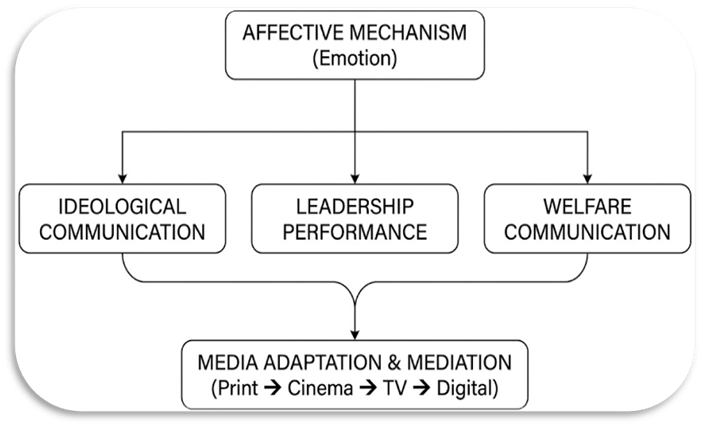
For regional parties operating within subnational democracies, such as the Dravidian parties of Tamil Nadu, standard singular frameworks (e.g., purely ideological or purely media-centric models) lack the analytical precision required to capture their long-term dominance. Instead, these parties deploy a hybrid strategy where distinct communication repertoires are structurally intertwined. We conceptualize this Hybrid Political Communication Model as an integrated matrix operating across four operationalized dimensions, bound together by an underlying affective mechanism.
1. Ideological Communication
Ideological communication provides the normative and intellectual framework that legitimizes party strategy. In the Dravidian context, this entails the discursive framing of rationalism, social justice, anti-caste egalitarianism, and subnational Tamil linguistic identity. Rather than remaining confined to abstract high theory, ideological communication here functions as popular political pedagogy. Complex sociopolitical tenets are translated into accessible, vernacular narratives that restructure the citizen's self-understanding within the polity[11]. Ideology serves as the moral anchor that validates the exercise of political will and the implementation of state policy.
2. Leadership Performance and Symbolism
Following Moffitt’s (2016) conceptualization of populism as a distinct political style, leadership communication is inherently performative and goes far beyond verbal or textual messaging. It encompasses physical gestures, cinematic iconographies, public rituals, and deeply institutionalized symbolic acts. The leader functions as a crucial discursive interface between institutional ideology and everyday citizen experience.
This dimension relies heavily on what Enyedi (2016)[2] terms "paternalistic populism," where leadership figures are constructed not merely as politicians, but as moral guardians who embody the collective will of "the people." As exemplified by figures like M.G. MGR and JJ, political communication is personalized; structural state welfare is discursively framed as an act of personal, emotional commitment and sacrificial protection, fostering deep-seated relational loyalties[10].
Welfare Communication Strategies:
Welfare policies do not communicate themselves through administrative implementation alone; rather, they are highly communicative and performative artifacts. We conceptualize this through an adaptation of the "commitment contract" framework[14], wherein material state provisions such as subsidized food or targeted social security schemes are embedded within a wider semiotic matrix of promises, signs, and moral obligations. Welfare communication translates material state delivery into a visible, affective proof of ideological commitment, transforming material dependency into a narrative of dignified, reciprocal care between the leadership and the subnational electorate.
3. Media Adaption and Technological Mediation
The structural layout through which these ideological, performative, and material dimensions are articulated is shaped by historical media transitions. Extending Norris’s (2000)[1] tripartite classification of pre-modern, modern, and post-modern campaigning, the Dravidian model demonstrates that media evolution is a cumulative rather than a displacement process.
The historical shift from theatre and print to cinema, television, and contemporary digital media ecosystems did not witness the erasure of older communicative practices. Instead, newer digital repertoires are systematically superimposed upon, and hybridized with, existing legacy styles. This media hybridity enables the parties to maintain narrative agility across diverse demographic segments simultaneously.
Crucially, emotion and affect do not constitute an isolated fifth category in this framework. Instead, following Papacharissi (2015)[3], affect is the underlying mechanism that animates and binds all four dimensions together. Ideology acquires emotional resonance through linguistic identity; leadership performance fosters loyalty and identification; and welfare delivery generates feelings of security and reciprocity among citizens. The framework provides a structured basis for comparing the communication strategies of the DMK and AIADMK. The following sections examine how these dimensions operate across different organizational, media, and political contexts in Tamil Nadu.
| Dimension | Core Function | Observable Indicators |
|---|---|---|
| Ideological Communication | Legitimation | Social justice, rationalism, Tamil identity |
| Leadership Performance | Personalization | Speeches, symbolism, charisma |
| Welfare Communication | Material legitimation | Welfare schemes, branding, policy narratives |
| Media Adaptation | Message transmission | Print, cinema, television, digital media |
Source: Author's compilation based on the literature reviewed in this study.
This study employs a qualitative-interpretive research design to examine the historical and contemporary political communication practices of the DMK and the AIADMK in Tamil Nadu. A qualitative framework is particularly appropriate because Dravidian political communication operates through vernacular language, visual symbolism, leadership performance, and regional cultural practices that require contextual interpretation. To ensure analytical rigor, the study adopts a triangulation strategy that combines multiple primary and secondary sources, including party manifestos, leadership speeches, party publications, regional newspapers, and archival materials.
The empirical analysis is further supported by a survey of 210 respondents drawn from rural and urban areas of Virudhunagar district. Respondents were selected across different income categories to capture diverse perspectives on political communication and party engagement. Virudhunagar district was selected because of its high ranking in the Tamil Nadu Human Development Index (2017), providing an appropriate setting for examining the communication strategies of the major Dravidian parties. Documentary and survey evidence were further contextualized through unstructured interviews and discussions with party functionaries, journalists, academics, and grassroots cadres, enabling a deeper understanding of the production, circulation, and reception of political messages.
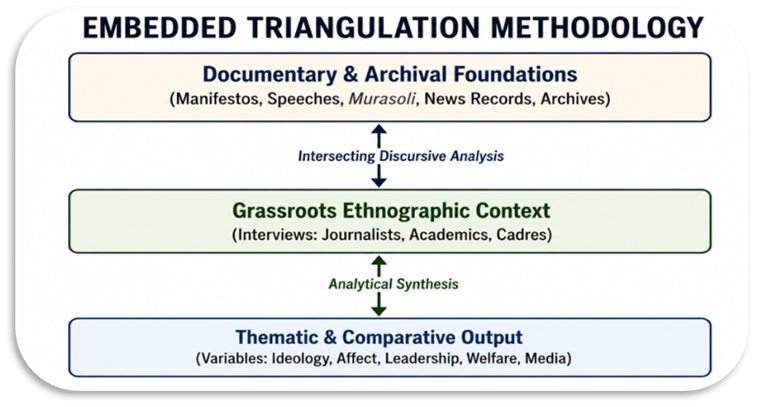
The empirical focus of this study spans the period from 2001 to 2021, covering five Tamil Nadu Assembly election cycles. This period is analytically significant because it captures both continuity and transformation in Dravidian political communication. It encompasses major changes in communication technologies, including the transition from print- and cinema-based mobilization to television-centred campaigning and digital media platforms. The period also includes important leadership transitions following the deaths of M. Karunanidhi and J. Jayalalithaa, providing an opportunity to examine how the communication strategies of the DMK and AIADMK were sustained beyond their iconic leaders. Examining this period therefore allows an assessment of how Dravidian parties adapted to changing political and media environments while maintaining organizational continuity and communicative relevance.
Methodologically, the study employs a combination of thematic and comparative analysis to identify recurring patterns across the four analytical dimensions of the Hybrid Political Communication Model: ideological communication, leadership performance and symbolism, welfare communication, and media adaptation. This approach facilitates a systematic comparison of the DMK and AIADMK as institutionalized communicators operating within a subnational democratic context. By integrating documentary, survey, and interview evidence, the study generates analytical insights into how regional parties sustain political legitimacy and electoral relevance across changing political environments.
The DMK and the AIADMK have developed extensive organizational structures that operate from local party units to the state leadership and serve as important channels of political communication. Drawing on the mobilizational traditions of the Dravidian movement and its precursor, the Dravidar Kazhagam, these organizational networks have historically functioned not only as electoral machines but also as mechanisms for political mobilization, ideological dissemination, and voter engagement[9, 10, 15]. Through party branches, cadre networks, public meetings, and organizational activities, both parties have communicated messages relating to social justice, welfare, and regional identity to diverse social groups across Tamil Nadu. As Ramajayam (2014)[15] argues, the significance of the Dravidian movement lies in its transformation of political communication from an episodic electoral activity into a continuous process embedded within everyday social and political life.
Despite their shared ideological origins, the DMK and AIADMK developed distinct organizational communication structures. The DMK operates through a multi-tiered organizational network that facilitates communication between state leaders, intermediate party units, and grassroots cadres. This structure encourages the circulation of ideological messages and supports a relatively collective style of leadership[11, 15]. In contrast, the AIADMK historically adopted a more centralized communication model, particularly under the leadership of MGR and J. Jayalalithaa. Communication within the party was largely directed from the leadership to party cadres and supporters, reinforcing personalized forms of political authority and direct leader-voter identification[10, 12]. These contrasting organizational arrangements illustrate different approaches to political communication: the DMK emphasizes organizational mediation and ideological integration, whereas the AIADMK has historically relied more heavily on centralized leadership and personalized communication.
Operating within India's federal political framework, both the DMK and AIADMK gradually moved from the radical mobilizational politics of the early Dravidian movement toward welfare-oriented electoral competition. Over time, welfare programmes became an important component of party communication, enabling both parties to connect governance with everyday citizen concerns. Rather than presenting welfare solely as administrative policy, party manifestos and public campaigns increasingly framed welfare provision as evidence of political commitment and responsiveness to social needs[2, 16]. This shift illustrates how organizational communication adapted to changing political contexts while maintaining the broader objectives of social justice and public mobilization associated with the Dravidian tradition[15].
Political communication in contemporary democracies extends beyond electoral campaigning and strategic messaging to encompass the construction of political identities, leadership narratives, and public legitimacy[1] [5]. In the context of Dravidian politics, the relationship between political communication, populism, and leadership is particularly significant for understanding the long-term resilience of regional parties. As Enyedi (2016)[2] argues, “paternalistic populism” combines emotional appeal with promises of welfare and protection, enabling political leaders to cultivate trust and legitimacy among citizens. Similarly, populist communication often relies on symbolic simplification and the construction of moral distinctions between “ordinary citizens and political elites”[7, 17]. However, in the Dravidian context, such appeals are rarely articulated in isolation. Rather, anti-elite rhetoric is frequently embedded within broader narratives of social justice, welfare provision, regional identity, and democratic representation, thereby linking populist communication to the wider ideological and communicative traditions of the Dravidian movement.
This conceptual paradigm directly illuminates the historical leadership models of MGR and J. Jayalalithaa, whose public messaging extended beyond electoral appeals to cultivate enduring relationships with citizens. Through speeches, symbolic performances, welfare initiatives, media appearances, and carefully constructed public personas, leadership was communicated not only as political authority but also as a form of care, protection, and public service. In this process, welfare programmes acquired communicative significance by reinforcing trust, loyalty, and reciprocal expectations between leaders and citizens. As Morelli et al. (2021)[14] suggest, such relationships may be understood as a form of "commitment contract" through which political legitimacy is sustained over time. The influence of these communicative practices continues to shape the contemporary strategies of both the DMK and AIADMK, even beyond the era of their iconic leaders.
The communication strategies of the DMK and AIADMK have played a central role in shaping political consciousness in Tamil Nadu. Dravidian politics has historically relied on a combination of public speeches, theatre, cinema, television, and digital media to communicate ideological messages and engage citizens. These media platforms have functioned not merely as instruments of political mobilization but also as cultural mechanisms linking political ideology with everyday social and political life.
|
|
Political Communication Tools of Dravidian Parties |
||
|---|---|---|---|
| S. No | Campaign Tools | S. No | Campaign Tools |
| 1 | Election Manifestos | 11 | Image cult |
| 2 | Cinema/Ideologues/Songs | 12 | Leaders’ speeches / Party’s Seminar or Conferences |
| 3 | Leaders writing | 13 | Organised party structure |
| 4 | Newspapers | 14 | Party symbols |
| 5 | Populism | 15 | Television channels |
| 6 | Social media | 16 | Social welfare policies |
| 7 | Street Campaigns | 17 | Wall Posters |
| 8 | Wall paints | 18 | Party’s Alliance |
| 9 | Political Ideology | 19 | Social base representatives |
| 10 | Protests | 20 | Public places (salons, tea shops, streets) as political communication tools. |
Source: Author’s field observation
The effectiveness of these communication tools depends not only on their availability but also on the credibility of the political actors who employ them. In the Dravidian context, leadership communication has played a crucial role in transforming electoral promises into politically meaningful commitments. J Jayalalithaa frequently presented welfare initiatives and campaign promises as expressions of personal responsibility toward the people of Tamil Nadu, thereby strengthening her public image as a responsive and trustworthy leader. Through speeches, welfare programmes, and symbolic communication, leadership credibility became closely associated with the broader communicative relationship between the party and its supporters. This illustrates how leadership performance functioned as an important dimension of Dravidian political communication.
|
Sources |
Assembly election |
Assembly election |
|---|---|---|
|
Senior journalist |
Jaya Network and Jaya TV |
|
|
Party senior member |
Puthiyathalaimurai News TV |
|
|
Vikatan archive |
YouTube channels (Tamil & English) |
|
|
Party web page |
Party senior member |
|
|
Dravidar Kazhagam archive |
Senior journalist |
|
|
The Hindu archive (Tamil & English) |
Vikatan Tamil channels |
|
|
Party journals |
Party web page |
|
|
Party archive |
Roja Muthiah Research Library |
|
|
Academicians |
|
Source: Author's compilation based on fieldwork, archival research, party documents, and media sources.
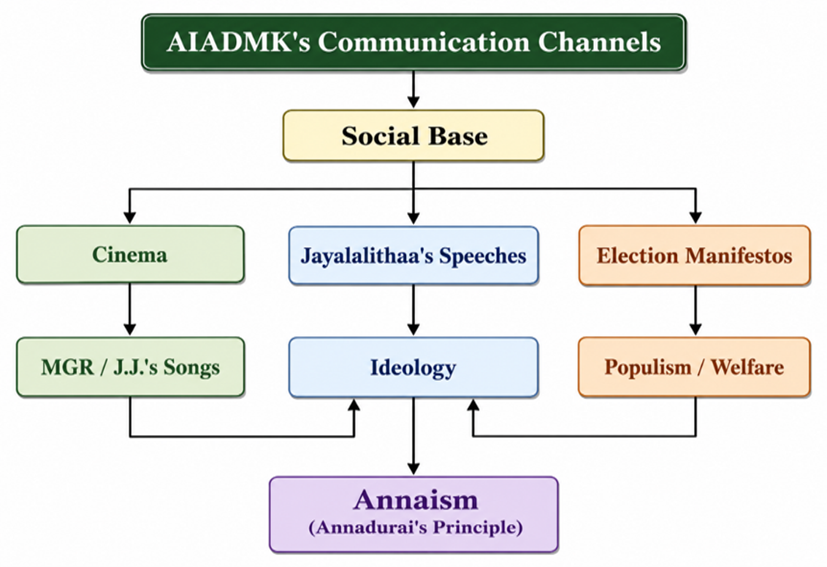
Founded by MGR in 1972 following a split from the DMK, the AIADMK developed a distinct communication strategy that combined cinematic charisma, centralized leadership, and welfare-oriented populism. While inheriting elements of the broader Dravidian tradition, the party moved away from the DMK's emphasis on ideological communication and instead relied more heavily on personalized leadership and symbolic representation[10].
MGR transformed cinema into a powerful medium of political communication, using film narratives to project an image of honesty, social justice, and concern for ordinary citizens[9]. Rather than functioning solely as entertainment, cinema became an extension of political messaging that linked the leader's screen persona with his political identity. As Kannan (2017)[18] notes, MGR further institutionalized this communication strategy by converting fan clubs into party networks, thereby translating popular appeal into organizational support. The durability of this communication model was evident during the 1984 Assembly election, when the AIADMK secured electoral success despite MGR's prolonged hospitalization.
Following MGR's tenure, this communicative legacy was inherited and reconfigured by J Jayalalithaa, who transformed the AIADMK into a highly centralized communication system centred on leadership authority. While consolidating her position within the party, she developed a distinctive style of political communication that combined organizational discipline, symbolic representation, and direct voter engagement. Her leadership was communicated through carefully constructed visual and rhetorical strategies, including her characteristic white sari with a party-coloured border, which projected both accessibility and authority[12]. These symbolic practices strengthened leader-centred communication and reinforced her position as the principal communicative face of the party.
Jayalalithaa further institutionalized a maternal mode of political communication that framed leadership as an act of care, protection, and public service. In public rallies, election campaigns, and party communication, she consistently employed maternal rhetoric to cultivate emotional identification with citizens. This strategy was encapsulated in her widely recognized slogan, "மக்களால் நான்...! மக்களுக்காகவே நான்..." ("I am by the people... I am for the people..."), which linked political authority with public welfare and personal commitment. The AIADMK's "Two Leaves" symbol, together with Jayalalithaa's visual imagery and campaign messaging, became important communicative markers that connected party identity, leadership legitimacy, and voter loyalty across Tamil Nadu.
Within this hybrid communication framework, state governance itself became a medium of political communication through the branding of welfare programmes. Initiatives such as Amma Unavagam (Amma Canteens), Amma Kudineer (Amma Drinking Water), Amma Marundhagam (Amma Pharmacies), Amma Salt, and the distribution of free laptops, mixers, grinders, and bicycles were closely associated with Jayalalithaa's public image. By attaching the "Amma" label to everyday welfare services, the AIADMK transformed routine policy delivery into a visible expression of leadership commitment and public care. Welfare therefore functioned not only as governance but also as communication, reinforcing what Morelli et al. (2021)[14] describe as a "commitment contract" between leaders and citizens through everyday experiences of state provision.
In the digital era, the AIADMK adapted its established communication practices to new media environments. Through its IT wing, leadership speeches, campaign messages, welfare narratives, and symbolic imagery were disseminated through social media platforms, mobile applications, and online networks. Core elements of the party's communication strategy, including leadership personalization, welfare branding, and emotional appeals, were repackaged for digital audiences while maintaining continuity with earlier forms of political mobilization. In this respect, digital media functioned less as a replacement for traditional communication and more as an extension of the party's existing communicative repertoire.
Politics in Tamil Nadu has long been shaped by caste-based social structures, and political communication frequently operates through these networks. While the Dravidian movement historically challenged caste hierarchies through the language of social justice, electoral mobilization has continued to rely upon caste-based communication channels and community organizations. In the case of the AIADMK, support among communities such as the Thevars in southern Tamil Nadu and sections of the Gounders in the Kongu region provided important networks for the circulation of party messages, leadership narratives, and welfare claims. Similarly, sections of the Arunthathiyars community maintained support for MGR and Jayalalithaa through local party intermediaries and community-based mobilization. In this sense, caste functioned not merely as an electoral category but also as a communication infrastructure linking party leadership with local social networks.
Both the DMK and AIADMK have recognized the importance of aligning organizational communication with local social structures. Consequently, the selection of district secretaries, party office-bearers, and electoral candidates often reflects the dominant caste composition of particular regions. In northern Tamil Nadu, for example, party organizations have frequently appointed leaders from the Vanniyar community, while similar patterns can be observed in other regions of the state. Such practices extend beyond electoral calculations; they facilitate communication between party leadership and local communities by embedding organizational structures within existing social networks. Through these arrangements, caste-based representation becomes an important mechanism for transmitting political messages, mobilizing supporters, and maintaining party presence at the grassroots level.
The concept of Dravida, given political meaning by E.V. Ramasamy (Periyar), has remained a foundational element of political communication in Tamil Nadu. Dravidian ideology (திராவிட சித்தாந்தம்) emerged as a framework that combined Tamil identity, anti-caste social reform, self-respect (suya mariyadhai), rationalism, social justice, and public participation. Unlike the AIADMK's greater reliance on leader-centred communication, the DMK has historically emphasized ideological communication, presenting politics as a vehicle for social transformation and public education. Consequently, party communication has extended beyond electoral mobilization to include the dissemination of social, cultural, and political ideas.
Drawing upon the legacies of the Justice Party and Periyar's Self-Respect Movement, the DMK institutionalized ideological communication under the leadership of C.N. Annadurai and M. Karunanidhi. Both leaders used cinema, literature, and public oratory to communicate social reform ideas to wider audiences[19, 20]. Karunanidhi's screenplay for Parasakthi (1952) remains a notable example, employing emotionally charged dialogue to popularize rationalist thought while reinforcing Tamil linguistic identity. His famous salutation, "என் உயிரினும் மேலான அன்பு உடன்பிறப்புகளே..." ("My dear brethren, who are more precious than my life..."), reflected a distinctive communicative style that combined literary Tamil with modern political language[21]. Similarly, Annadurai and Karunanidhi transformed public meetings into performative political spaces where ideology, entertainment, and mass mobilization intersected[11].
The DMK's communication strategy also relied on cultural and theatrical networks that extended beyond formal party structures. The party maintained close links with influential performers such as M.R. Radha and his Social Reform Company, whose plays promoted anti-caste, rationalist, and atheist themes aligned with the objectives of the Dravidian movement. These theatrical interventions expanded the communicative reach of both the Dravida Kazhagam (DK) and the DMK, enabling political ideas to circulate through popular cultural spaces. This cultural infrastructure contributed to the party's long-term organizational resilience and helped sustain ideological communication across successive generations of political leadership[11].
Organizationally, the DMK reinforced its ideological communication through a decentralized yet coordinated communication structure that linked local party units with the state leadership. This organizational network enabled the circulation of messages, political education, and feedback across different levels of the party. The party's flagship publication, Murasoli, functioned not merely as an official newspaper but also as an important platform for ideological discussion and cadre engagement, helping maintain organizational cohesion and communicative continuity over time[11].
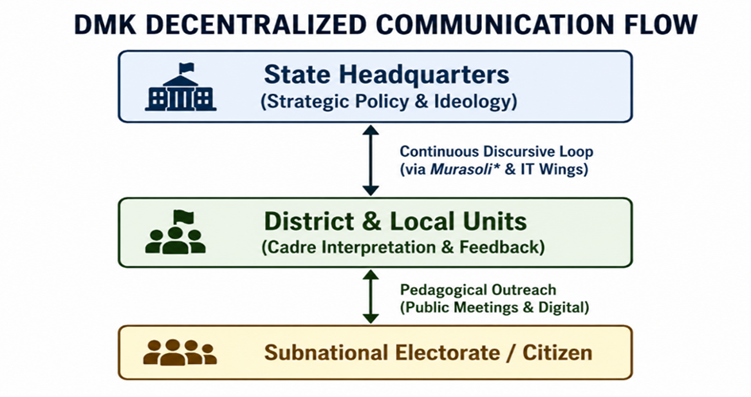
Under the leadership of M.K. Stalin, the DMK has extended this communication infrastructure into digital spaces through social media platforms, online campaigns, and mobile applications. While adapting to changing media environments, the party has continued to emphasize themes of social justice, federalism, and Dravidian identity, demonstrating how ideological communication can be sustained across both traditional and digital media.
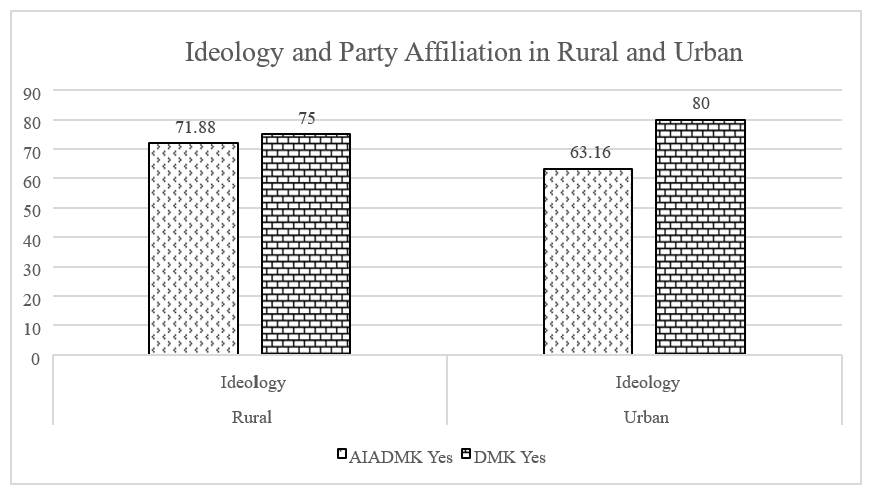
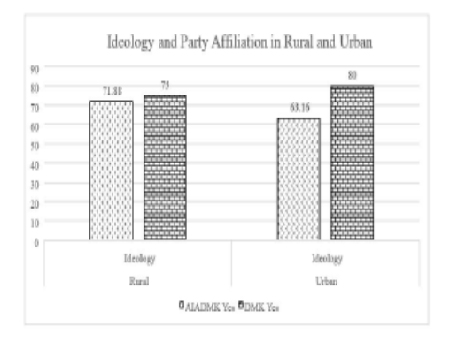
Survey findings on ideological identification reveal important differences between the two Dravidian parties. As shown in [Fig. 5], respondents associated the DMK more strongly with Dravidian ideological principles in both rural and urban areas, with the highest level of identification recorded among urban respondents (80%). The AIADMK also retained substantial support, particularly in rural areas (71.88%), indicating the continued relevance of its organizational and welfare-based communication networks. These findings suggest that the DMK's communication strategy remains more closely associated with themes of social justice, rationalism, and Dravidian identity, whereas support for the AIADMK appears to be shaped to a greater extent by leadership symbolism and welfare-oriented communication. Notably, a significant proportion of unaffiliated urban respondents (65.22%) also demonstrated awareness of Dravidian ideological themes, suggesting that these ideas continue to influence political discourse beyond formal party affiliation.
| Analytical Dimension | DMK | AIADMK |
|---|---|---|
| Ideological Communication | Rationalism, Social Justice, Tamil identity, Dravidian ideology | Annaism, Welfare-oriented populism, Dravidian legacy |
| Leadership Performance and Symbolism | Intellectual and participatory leadership (Annadurai, Karunanidhi, Stalin) | Charismatic and personalized leadership (MGR, Jayalalithaa) |
| Welfare Communication | Welfare linked with social justice and developmental governance | Welfare branding through Amma schemes and maternal symbolism |
| Media Adaptation and Communication Platforms | Theatre, literature, Murasoli, party media, social media campaigns | Cinema, television, fan clubs, welfare branding, social media outreach |
| Organizational Communication Style | Cadre-based, decentralized, bottom-up communication | Centralized, leader-centred, top-down communication |
Source: Author’s compilation
Although the DMK and AIADMK emerge from a shared Dravidian political tradition, their contemporary communication strategies exhibit important similarities and differences. To systematically evaluate these patterns, this section compares the two parties across the four analytical dimensions of the Hybrid Political Communication Model: ideological communication, leadership performance and symbolism, welfare communication, and media adaptation. This comparative framework enables an assessment of how each party has combined continuity and adaptation in sustaining political communication within Tamil Nadu's subnational democratic context.
Despite their distinct communication strategies, both the DMK and the AIADMK converge in their reliance on competitive populism, characterized by the continuous expansion of welfare promises, symbolic leadership, and voter outreach. This sustained political rivalry has made welfare communication and emotional mobilization enduring features of Tamil Nadu's political landscape[16]. While the Dravidian movement originated as a project of rationalist social reform and political education, its contemporary communication strategies increasingly combine ideological messaging with affective appeals and symbolic representation. Consequently, both parties have adapted Dravidian political communication to changing electoral and media environments while retaining their broader commitment to social welfare and popular mobilization.
A key feature of Dravidian political communication is its ability to establish cultural intimacy between political leaders and citizens. By employing familiar linguistic styles, cultural references, and regionally resonant symbols, leaders transform political communication into a shared social experience rather than a simple transmission of policy messages. This communicative practice can be observed across different leadership styles, ranging from Karunanidhi's literary and ideological oratory to Jayalalithaa's maternal and welfare-oriented rhetoric. In both cases, political legitimacy is strengthened through culturally embedded forms of communication that connect leadership narratives with everyday social experience.
Taken together, these patterns demonstrate that Dravidian political communication combines ideology, leadership performance, and cultural symbolism within a durable framework of democratic mobilization.
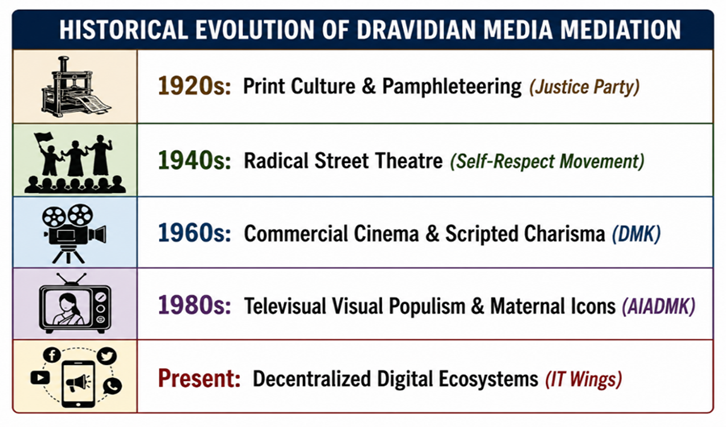
The evolution of Dravidian media reflects broader changes in political communication rather than a simple technological transition. The early leaders of the Justice Party and the Self-Respect Movement relied on pamphlets, public meetings, and street theatre to challenge caste hierarchies and promote social reform. Under C.N. Annadurai and M. Karunanidhi, these communicative practices expanded into cinema, enabling rationalist and social justice messages to reach wider audiences through popular cultural forms[9]. As media environments changed, both the DMK and AIADMK adapted these established communication traditions to television and later to digital platforms, ensuring the continued relevance of Dravidian political narratives across successive generations.
By the 1980s, Dravidian political communication increasingly emphasized visual representation, leadership symbolism, and welfare-centred messaging under MGR and J. Jayalalithaa. While retaining elements of the broader Dravidian tradition, political communication became more personalized and media-driven, with cinema, television, and welfare branding playing central roles. Slogans such as "Anaivarukkum Amma" ("Mother for All") and the widespread visibility of Amma-branded welfare schemes linked leadership identity with everyday experiences of governance, strengthening emotional connections between leaders and citizens.
Over the last two decades, both the DMK and the AIADMK have extended their established communication practices into digital media environments. Party IT wings, social media teams, and online campaign networks now disseminate leadership messages, welfare narratives, and political content across platforms such as X, YouTube, WhatsApp, and Instagram. While the technologies have changed, the underlying communicative logic remains consistent: political messages continue to combine ideology, symbolism, leadership, and emotional appeals to engage supporters and shape public discourse.
The interaction between localized social networks and broader narratives of social justice, welfare, and development remains a defining feature of Dravidian political communication. While both parties employ inclusive political language at the state level, local organizational structures facilitate the communication of these messages across diverse social groups. Party workers and community-level leaders therefore act as important intermediaries, translating broader ideological narratives into locally meaningful political messages. This combination of universal appeals and localized communication has contributed to the long-term resilience of Dravidian political mobilization in Tamil Nadu.
Southern Districts: Communication networks are frequently mediated through influential regional communities, particularly the Thevars and Pallars.
Northern Districts: Local organizational structures often correspond with the demographic presence of Vanniyar and Paraiyar communities.
Western Region: Regional mobilization and cadre networks are commonly anchored within Gounder and Arunthathiyars social networks (Harriss, 2000).
These patterns illustrate how Dravidian political communication operates simultaneously through broad ideological appeals and localized social networks. While both parties employ universal narratives centred on social justice, welfare, and development, the dissemination of these messages often relies upon regionally embedded community structures. Local party workers and community leaders serve as important intermediaries, translating broader political narratives into forms that resonate with the everyday social and economic experiences of different groups. This combination of statewide messaging and localized communication has contributed to the durability of Dravidian political mobilization across Tamil Nadu.
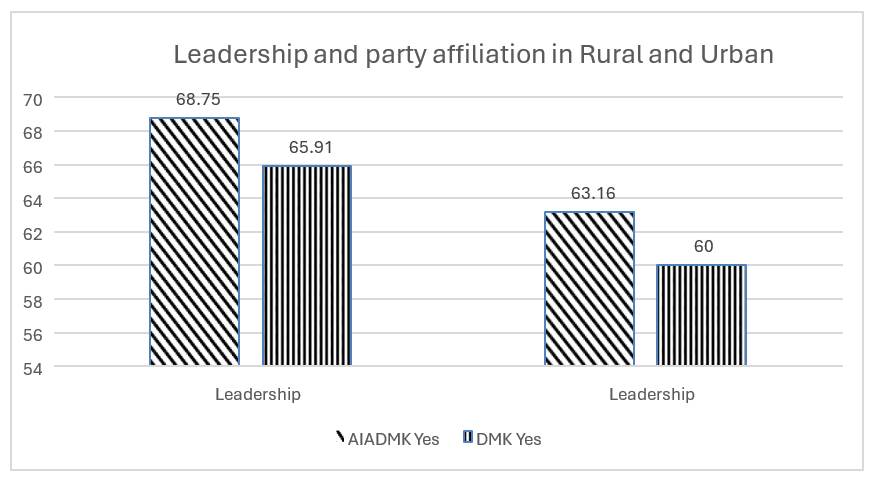
To evaluate how effectively leadership communication sustains political support, this study examines patterns of voter alignment across rural and urban contexts. As shown in [Fig. 7], emotional attachment to leadership remains relatively strong across both settings. Support linked to emotional leadership declined only modestly from rural to urban areas for both the AIADMK (68.75% to 63.16%) and the DMK (65.91% to 60.00%). These findings suggest that leadership continues to function as an important communicative resource across different social environments. Rather than disappearing with urbanization and social change, emotional and symbolic attachments to political leaders remain embedded within the political culture of Tamil Nadu.
These findings challenge the assumption that urbanization and socio-economic transformation necessarily weaken regional party attachments. The relatively modest decline in emotional identification between rural and urban respondents suggests that leadership-based political communication remains influential across different social settings. Emotional attachment to Dravidian leadership continues to function as an important source of political identification, operating as a social resource in rural areas while remaining culturally meaningful within urban environments. The findings therefore indicate that emotional leadership remains a durable component of political communication in Tamil Nadu despite broader processes of modernization and social change.
The findings highlight the importance of leadership communication and symbolic representation within Dravidian politics. Each generation of leaders developed a distinctive communicative style that reflected both individual personality and changing political contexts. C.N. Annadurai employed conversational language and intellectual humour, often addressing audiences as "அன்புள்ள நண்பர்களே!" ("Dear Friends..."). Karunanidhi relied on literary oratory and ideological persuasion, reflected in his well-known salutation, "என் உயிரினும் மேலான அன்பு உடன்பிறப்புகளே..." ("My dear brethren, who are more precious than my life..."). MGR combined cinematic symbolism with a language of protection and care, frequently addressing supporters as
"என் அருமைத் தாய்மார்களே, சகோதர சகோதரிகளே..."
("My dear mothers, brothers, and sisters..."). Jayalalithaa further institutionalized this communicative tradition through a maternal political rhetoric that linked leadership authority with welfare provision and public care. Together, these leadership styles demonstrate how emotional attachment and symbolic communication have remained central to political mobilization in Tamil Nadu.
These leadership styles reflect broader patterns of paternalistic and symbolic political communication identified by Enyedi (2016)[2], where authority is combined with emotional appeal and public responsiveness. In the Dravidian context, political communication extends beyond speeches and campaign messages to include visual symbolism, public rallies, welfare distribution, media appearances, and other performative forms of engagement. Consequently, leadership is communicated not only through what political actors say, but also through how they are seen, experienced, and remembered by citizens.
A defining feature of the Dravidian political model is the integration of political communication into everyday governance. Welfare initiatives such as the Kalaignar Housing Scheme and Amma Unavagam (Amma Canteens) function not only as policy interventions but also as communicative artefacts that reinforce political legitimacy. Through speeches, campaign narratives, slogans, and visual symbolism, these programmes are presented as expressions of leadership commitment and public responsibility rather than routine administrative measures. In this sense, governance itself becomes a medium of political communication.
Welfare programmes are frequently communicated as visible expressions of leadership responsibility and accountability. This communicative practice reflects what Morelli et al. (2021)[14] describe as a "commitment contract" between political leaders and citizens, in which welfare delivery reinforces expectations of responsiveness, care, and public service. Through everyday encounters with welfare schemes, citizens experience governance not only as administration but also as an ongoing form of political communication.
The Dravidian experience broadens existing understandings of political communication by demonstrating how ideology, emotion, and governance can be sustained through continuous cultural adaptation. The comparative analysis shows that both the DMK and the AIADMK combine ideological narratives with emotional appeals, enabling political communication to remain relevant across changing social and media environments. Within this hybrid framework, political communication performs three interconnected functions: it provides political education by translating ideas of social justice, rationalism, and equality into an accessible public language; it generates affective mobilization by fostering emotional attachment and collective identity; and it supports performative governance by transforming welfare delivery into a visible expression of political commitment. Together, these functions illustrate how Dravidian political communication has maintained long-term political relevance while adapting to changing forms of media and democratic participation.
This study demonstrates that Dravidian political communication is best understood as a hybrid system in which ideology, leadership, emotion, media, and governance operate as mutually reinforcing dimensions rather than separate political processes. The comparative analysis of the DMK and AIADMK shows that communication extends beyond the transmission of information and functions as an ongoing process through which political legitimacy, public participation, and democratic engagement are sustained. By combining cultural symbolism, welfare communication, organizational networks, and media adaptation, both parties have developed durable forms of political communication that remain influential across changing political and technological environments.
From the perspective of political communication theory, the findings challenge the assumption that ideology and emotion operate as competing modes of political persuasion. In the Dravidian context, emotional appeals do not replace ideological commitments; rather, they serve as the primary means through which ideas such as social justice, self-respect, rationalism, and Tamil identity are communicated and experienced by citizens. This suggests that affect functions not as a distortion of democratic communication but as an important mechanism through which political identities, collective attachments, and public participation are sustained. The Dravidian experience therefore highlights the need to examine ideology and emotion as mutually reinforcing dimensions of political communication rather than as opposing forces.
Furthermore, the findings extend existing debates on populism by demonstrating that populist communication is not confined to electoral campaigns or charismatic leadership alone. In the Dravidian context, populist communication is sustained through everyday practices of governance, particularly through the delivery and symbolic framing of welfare programmes. Welfare initiatives function not only as policy interventions but also as communicative mechanisms that reinforce leadership credibility, political responsiveness, and citizen engagement. This pattern supports the idea that populism can be institutionalized through governance structures, allowing political attachment to be maintained beyond election periods. The Dravidian experience therefore highlights how welfare communication contributes to the long-term durability of populist political projects.
The comparative analysis demonstrates that the hybrid communication model accommodates significant strategic variation. While the DMK relies more heavily on ideological continuity, collective leadership, and cadre-based communication, the AIADMK has historically emphasized centralized leadership, personalization, and welfare-centred communication. Despite these differences, both parties converge in their use of cultural symbolism, welfare narratives, and media adaptation. This convergence suggests that hybrid political communication has become institutionalized within Tamil Nadu's party system rather than remaining dependent on individual leaders alone.
These findings offer three broader implications for political communication scholarship. First, they demonstrate that subnational parties can serve as important sites of theoretical innovation rather than merely local variations of national political processes. Second, they show how communication in non-Western democracies often combines performance, policy, and persuasion within culturally embedded political repertoires. Third, they indicate that transitions from cinema and television to digital media do not necessarily replace earlier communication practices; instead, new technologies are incorporated into existing communicative traditions. In this respect, contemporary political engagement is increasingly shaped through affective publics built around visibility, shared experiences, and mediated participation[3].
This study has shown that the political communication of the DMK and AIADMK cannot be understood solely through electoral campaigns, media strategies, or charismatic leadership. Instead, Dravidian political communication operates through the interaction of ideology, cultural performance, welfare practices, organizational networks, and media adaptation. While the two parties differ in their communication styles, both have sustained political relevance by continuously adapting their messages to changing social and technological contexts without abandoning their broader Dravidian foundations.
The findings demonstrate that political communication in Tamil Nadu functions not only as a mechanism of persuasion but also as a process through which political identities, social meanings, and democratic relationships are reproduced over time. As one elderly voter observed during a field interview, “In Tamil Nadu, politics is not merely stated; it is performed.” This observation captures how communication remains embedded in everyday political life through language, symbols, welfare practices, and public performance.
The Dravidian experience contributes to political communication scholarship by illustrating how regional parties sustain long-term democratic engagement through the continuous adaptation of communicative practices across successive media environments. The Hybrid Political Communication Model proposed in this study offers a framework for understanding how subnational political actors combine ideology, emotion, governance, and media to maintain political legitimacy in diverse democratic settings.
I would like to express my sincere gratitude to the reviewers for their valuable comments and suggestions, which helped improve this paper. I am especially thankful to my Ph.D. supervisor for their continuous guidance and support in developing this idea into a research paper. I also extend my appreciation to the Library of the ISEC for providing access to the necessary research materials and resources. Additionally, I would like to thank the ISEC Working Paper Series team, as an earlier version of this article was previously published under a different title and structure. Finally, I am deeply grateful to all the respondents who participated in the field study and generously shared their time and insights, making this research possible.
The author declares that there are no competing interests.
No funding was received for this research.
The data supporting the findings of this study are available from the corresponding author upon reasonable request.
[1] Political communication is multifaceted in nature, but this context only relates to electoral politics. When communication came to the field of political science, it created horizontal communication between political actors and voters and was friendly to the democratic system. According to Norris (2000), consider three different communication stages, regarding campaigns: pre-modern, modern, and postmodern.
1. Norris P. A virtuous circle: Political communications in post-industrial societies. Cambridge University Press. Cambridge. 2000.
2. Enyedi Z. Populist Polarization and Party System Institutionalization. Problems of Post-Communism. 2016; 63 (4). Available from: https://doi.org/10.1080/10758216.2015.1113883
3. Papacharissi Z. Affective publics: Sentiment, technology, and politics. Oxford University Press. Oxford. 2015
4. Denton RE Jr, Woodward GC. Political communication in America. 2nd ed. Praeger. New York. 1990
5. Gonçalves G. Political communication. Universidade da Beira Interior. Covilhã. 2018
6. McNair B. AN Introduction to Political Communication. 2017; 6th Ed Available from: https://doi.org/10.4324/9781315750293
7. Mudde C. The Populist Zeitgeist. Government and Opposition. 2004; 39 (4). Available from: https://doi.org/10.1111/j.1477-7053.2004.00135.x
8. Kothari R. The party system: Form and substance in Indian politics. Economic Weekly. 1961;13(5):119–126.
9. Hardgrave RL Jr. Politics and the Film in Tamilnadu: The Stars and the DMK. Asian Survey. 1973; 13 (3). Available from: https://doi.org/10.1525/as.1973.13.3.01p0314o
10. Pandian MSS. The image trap: M.G. Ramachandran in film and politics. Sage Publications. New Delhi. 1992
11. David Ludden. Ethnicity and Populist Mobilization: Political Parties, Citizens, and Democracy in South India. By Narendra Subramanian. Delhi: Oxford University Press, 1999. 371 pp. $35.00 (cloth); $11.95 (paper).. The Journal of Asian Studies. 2001; 60 (4). Available from: https://doi.org/10.2307/2700090
12. Vaasanthi. Amma: Jayalalithaa's journey from movie star to political queen. Juggernaut. New Delhi. 2016
13. Kalaiyarasan A, Vijayabaskar M. The Dravidian model: Interpreting the political economy of Tamil Nadu. Cambridge University Press. Cambridge. 2021; Available from: https://doi.org/10.1017/9781108933506
14. Morelli M, Nicolò A, Roberti P. A Commitment Theory of Populism. SSRN Electronic Journal. Available from: https://doi.org/10.2139/ssrn.3982036
15. Ramajayam P. Reinforcing Dravidian identity politics in Tamil Nadu. Oxford University Press. New Delhi. 2019.
16. Harriss J. Populism, Tamil style: Is it really different? In: Frankel F et al., editors. Transforming India: Social and Political Dynamics of Democracy. Oxford University Press. New Delhi. 2000:132–154.
17. Aalberg T, Esser F, Reinemann C, Strömbäck J, de Vreese CH. Populist political communication in Europe. Routledge. London. 2017.
18. Kannan R. MGR: A life. Penguin Random House India. New Delhi. 2017. .
19. Muthukumar R. Dravida Iyakka Varalaru I & II [The history of the Dravidian movement]. Kizhakku Pathippagam. Chennai. 2010.
20. Thirunavukkarasu K. The history of the Justice Party, 1914–1944. Nakkeeran Publications. Chennai. 2013.
21. Shankar SR. Karunanidhi: A life in politics. HarperCollins India. New Delhi. 2018.
© 2026 Published by Bangalore University. This is an open-access article under the CC BY license (https://creativecommons.org/licenses/by/4.0/)
Subscribe now for latest articles and news.